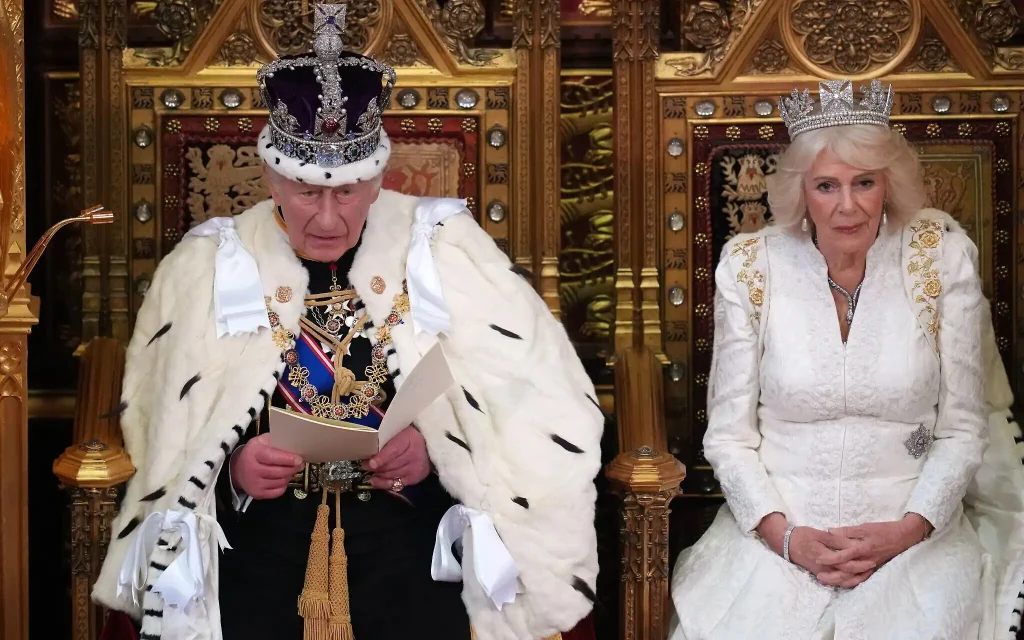
Roger-Luc Chayer (Image : Kirsty Wigglesworth/AP)
Misinformation about King Charles III and the Ban on Conversion Therapies
A piece of false information has been widely circulating on the web for the past two days concerning King Charles III of the United Kingdom, as well as Canada, claiming that he had ordered the ban on conversion therapies. This has triggered waves of congratulations around the world. However, this news is largely misleading and stems from a misunderstanding of how the British parliamentary system works.
What are conversion therapies?
Conversion therapies refer to a set of practices that claim to modify a person’s sexual orientation or gender identity in order to make them heterosexual or aligned with the gender assigned at birth. They are based on the idea — widely rejected by medical and psychological organizations — that these aspects of identity are behaviors or disorders that can be corrected.
In practice, these methods can take various forms, ranging from pseudo-therapeutic counselling sessions to more coercive or humiliating approaches. They are now denounced by numerous health and human rights organizations, which consider them ineffective and potentially psychologically harmful.
King Charles III does not have the power to ban conversion therapies
Obviously, claiming that King Charles has the power to decree such a ban is false, since he does not hold legislative power. The King is the head of state, but it is Parliament that passes laws in the United Kingdom. So where does the confusion come from?
The King’s Speech (State Opening of Parliament) of 13 May 2026 explained
During the King’s Speech on 13 May 2026, King Charles III read a text written by the British government as part of the opening of the parliamentary session. This speech does not reflect the monarch’s personal decisions, but officially presents the government’s legislative program for the coming months.
It is in this context that the British government’s intention to legislate to ban conversion therapies appears. The King therefore announced this measure only in the ceremonial sense: he read the government’s program before Parliament, without being its author or decision-maker.
The ceremonial role of the King in the British constitutional monarchy
In the British constitutional system, the King’s Speech is a symbolic moment where the head of state, in this case King Charles III, officially opens the parliamentary session. However, the content is entirely prepared by the Prime Minister and his cabinet. The King’s role is therefore ceremonial: he embodies the State and ensures institutional continuity, while the power to propose, debate and pass laws belongs exclusively to Parliament.
It is this distinction that explains the frequent confusion. The public may get the impression that the King “announces” decisions, whereas in reality he is the institutional spokesperson, without direct political power.
Real powers of King Charles III: constitutional monarchy
In the British system, the powers of the King are largely formal and exercised on the advice of the government, but there are a few very limited cases where we speak of “royal prerogative powers”. In practice, they are almost always framed by constitutional convention, which means that the King does not act freely.
Theoretically, the monarch still has certain powers such as the appointment of the Prime Minister, the dissolution of Parliament or royal assent to laws. However, in modern reality, these decisions are taken in accordance with election results and government recommendations.
Even if the King formally retains certain powers, the United Kingdom is a constitutional monarchy where the real decision-making power belongs to Parliament and the government, and not to the sovereign.
Good news for LGBTQ+ communities
But the mere fact of announcing, in his speech, the government’s intention to ban conversion therapies constitutes excellent news for people in LGBTQ+ communities who suffer from the harmful effects and after-effects of these practices.
ADVERTISING
READ ALSO