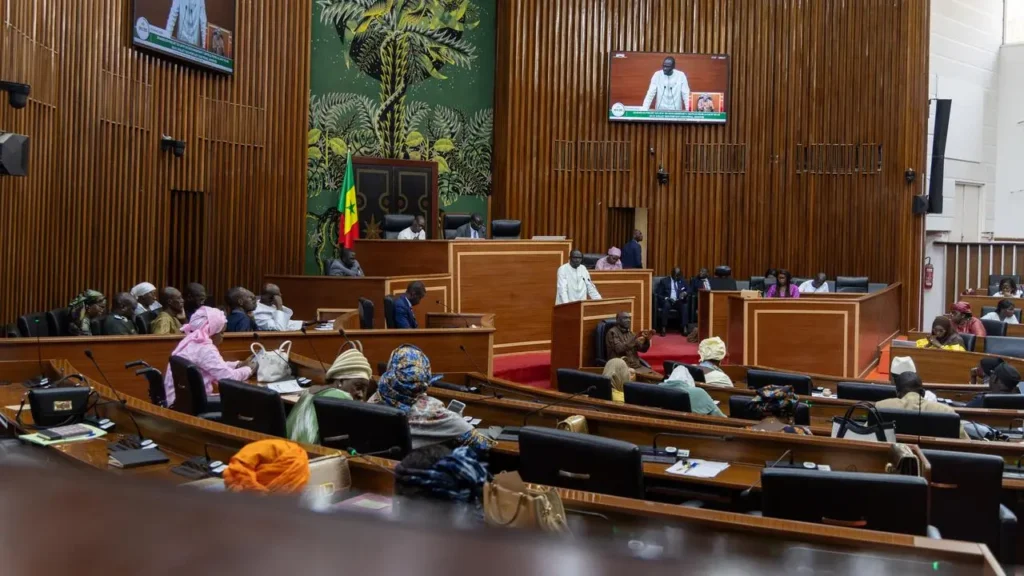
Opinion by Roger-Luc Chayer (Photo: Senegalese Parliament / RTS)
On June 18, 2026, Quebec-based airline Air Transat proudly announced a new direct flight between Montreal and Dakar, the capital of Senegal. For me, however, this was nothing to celebrate. The Quebec airline, which bears responsibility for the safety of its passengers, will now be flying some of its customers directly into what could become a nightmare, as Senegal remains one of the countries that most aggressively criminalizes homosexuality.
Simple suspicion can be enough to have someone arrested and imprisoned at the discretion of the authorities.
In Senegal, same-sex sexual relations are criminalized under the Penal Code. In practice, this means that so-called “unnatural acts” can be prosecuted, carrying penalties that may include several years of imprisonment depending on the circumstances.
There is no legal recognition of same-sex couples, and society remains broadly conservative on these issues. That said, the enforcement of these laws and the visibility of prosecutions can vary over time and according to specific situations.
The country is predominantly Muslim, with a strong influence from Sufi religious brotherhoods, and prevailing social norms place great importance on traditional values related to family and religion. In this context, homosexuality is often viewed not only as a moral issue but also as a challenge to the social and religious order.
It is also important to consider the colonial legacy. The laws criminalizing so-called “unnatural acts” originate in part from penal codes inherited from the French colonial period and maintained after independence. These provisions have not undergone significant reform since then.
Politically, the issue has become extremely sensitive. Political leaders, operating in an environment where religion plays a powerful social role, generally avoid reforms perceived as “Western” or imposed from abroad. In some cases, public discourse and social mobilization have even reinforced the stigmatization of LGBT people.
What Is Air Transat’s Responsibility Toward Its Gay Passengers?
An airline has a general obligation to ensure safety during transportation, but this obligation primarily concerns the physical integrity of passengers on board the aircraft and the conditions of the flight itself. It is governed by international rules such as the Montreal Convention and transportation regulations, particularly in Canada. This means that the airline must take all reasonable measures to prevent harm related to the flight itself, including accidents, injuries, delays, or transportation conditions, and may be held liable if negligence occurs.
Once passengers arrive in a foreign country, however, responsibility for the local legal environment does not belong to the airline. Air Transat cannot be held responsible for the laws in force in Senegal or for decisions made by local authorities. Legal obligations and risks associated with entering the country, regardless of a passenger’s nationality or sexual orientation, fall under the authority of the destination state, not the airline.
In the specific case of LGBT travelers, the Senegalese legal framework is well known, and criminalization applies to acts committed within Senegalese territory. Legally, however, an airline cannot refuse transportation based on a passenger’s actual or presumed sexual orientation, nor can it shield someone from the laws of the country to which they are traveling, provided that person possesses the documents required for entry.
Legally speaking, Air Transat has no obligation to protect its gay passengers beyond the scope of aviation safety. Morally, however, the issue is different. Entering into a commercial relationship with a country whose laws conflict with the values and legal principles of Quebec may be seen by some as a questionable moral choice.
Furthermore, on the Government of Canada’s travel advisory page for Senegal, the section concerning 2SLGBTQI+ persons states:
“Senegalese law criminalizes sexual acts between persons of the same sex. Since the enactment of legislation on March 31, 2026, individuals accused of homosexuality, as well as its ‘promotion’ or ‘financing,’ may face heavy fines and prison sentences of up to ten years. This could include scrutiny of your online presence if it reveals information about your sexual orientation, gender identity, gender expression, or public positions.”
According to the advisory, 2SLGBTQI+ people are regularly subjected to harassment and violence by members of the public and local authorities.
Law enforcement agencies sometimes carry out arbitrary arrests and searches based on sexual orientation or gender identity. Such interventions may include:
- Detention;
- Interrogation;
- Alleged physical violence.
2SLGBTQI+ travelers are advised to avoid public displays of affection and carefully assess the risks associated with travel to Senegal.
So be aware: yes, authorities may examine your online history, and if they find references or indications related to what has been described above, you could find yourself in prison. And it certainly will not be Air Transat that comes to bring you oranges.
ADVERTISING