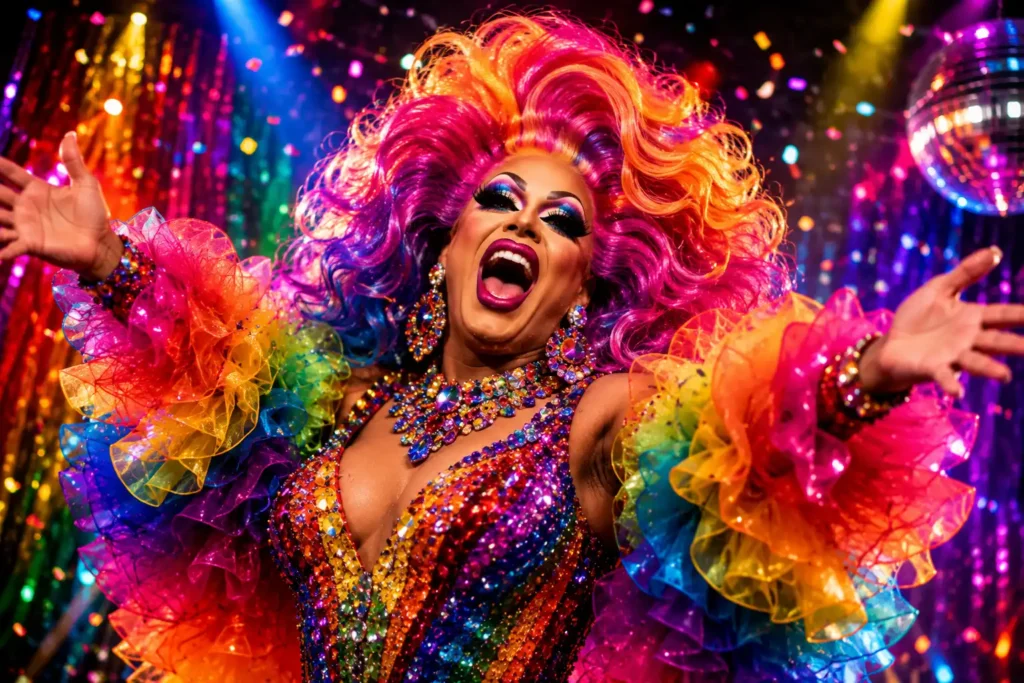
Arnaud Pontin (Image : AI / Gay Globe)
“I’ve had enough of drag queens everywhere. It’s as if everything related to gay people now has to be associated with drag queens, and it’s disproportionate,” reads a message sent by a Gay Globe subscriber commenting on the perceived overrepresentation of drag queens in the public sphere.
He did not say that drag queens should be kept away from children, nor did he suggest any form of hidden indoctrination. Rather, he argued that this constant association between gay people and drag queens has gone too far, and that he does not identify with this trend that has persisted for several years.
Let us examine the situation.
The drag queens movement did not develop as an organized political movement, but rather as a form of artistic and cultural expression whose origins date back several centuries.
The term “drag” is generally associated with men performing female characters on stage. From Antiquity through the modern era, women were often excluded from theatre in many societies. Men therefore played female roles in theatrical productions, notably in the England of William Shakespeare during the 16th and 17th centuries.
The modern form of drag queens emerged mainly in the late 19th and early 20th centuries in cabarets, music halls, and variety shows in the United Kingdom and the United States. These performers no longer simply portrayed female roles; they developed exaggerated, humorous, or glamorous characters that became performances in their own right.
From the 1920s and 1930s onward, drag queens and related forms of transformist performance gained popularity in major cities, while remaining largely marginalized due to laws and prejudices targeting homosexual people and those who did not conform to gender norms.
Drag queens became particularly visible in bars and clubs frequented by homosexual communities after the Second World War. In several American cities, they played an important role in the social life of these communities, often at a time when homosexuality was still criminalized or heavily stigmatized.
The link between drag queens and the homosexual liberation movement strengthened after the Stonewall Riots. Although historians still debate the exact role played by drag queens in these events, several figures associated with drag performance and gender nonconformity took part in the mobilizations that followed.
From the 1980s and 1990s onward, drag queens became increasingly visible in popular culture through live performances, film, and television. This visibility exploded in the 21st century with shows such as RuPaul’s Drag Race, which turned drag into a global cultural phenomenon.
It is often claimed that drag queens were at the origin of the first gay pride marches in Montreal. However, this claim does not hold up to historical scrutiny.
Historically, the first Pride march in Montreal was organized in 1979 by gay activist John Banks and the Brigade Rose, marking the 10th anniversary of the Stonewall Riots. This initiative came from gay and lesbian activists engaged in civil rights advocacy and homosexual visibility, not from a drag queens movement.
It is true that drag queens have participated at various points in the history of LGBT communities, both in New York and Montreal, and that they have often contributed to the cultural visibility of sexual minorities. However, the origins of Montreal Pride are more closely linked to gay activism, reactions to police raids in gay bars, the fight against discrimination, and the influence of Stonewall events.
Several historians also emphasize that the emergence of the gay liberation movement in Montreal is more closely associated with events such as the 1977 police raid on the Truxx bar, the protests that followed, and the organization of gay and lesbian activist groups, rather than with a drag queens movement specifically.
And elsewhere in the world?
What is now known as drag queens culture is largely a phenomenon that developed in North America, particularly in the United States, before spreading to various Western countries. Its current popularity is largely driven by television, social media, and shows such as RuPaul’s Drag Race.
In several Western countries such as Canada, the United States, the United Kingdom, Australia, and parts of France, drag performances are relatively visible and sometimes integrated into Pride events.
By contrast, in much of Africa, the Middle East, Central Asia, and parts of South Asia, drag culture is either marginal or virtually absent from public space. In some countries, laws or social norms make such performances difficult or risky.
It is also important to distinguish Western drag queens from other cultural traditions. For example, Japan has long-standing theatrical forms in which men portray female roles, such as Kabuki, but this does not necessarily correspond to modern drag culture. Likewise, many cultures have their own forms of artistic cross-dressing that are not connected to contemporary LGBT movements.
It is therefore difficult to speak of a universal trend. The current visibility of drag queens is mainly concentrated in Western societies and large urban centers influenced by North American media culture.
How can the increased visibility of drag queens in recent years be explained?
Several factors may account for the growing presence of drag queens in the public sphere over the past fifteen years. First, the international success of television programs dedicated to drag performance has introduced this art form to a much wider audience than before. What was once mainly confined to cabarets, bars, and community events has gradually become mainstream entertainment.
Social media has also played a major role. The visual, colorful, and often spectacular nature of drag queens performances fits particularly well with digital platforms, where short videos and images quickly attract attention.
In addition, many organizations, festivals, and companies have seen drag queens as highly visible spokespersons for sexual and gender diversity. Their media presence is often perceived as a way of demonstrating openness and inclusion.
This increased visibility, however, is not unanimously accepted, even within LGBT communities. Some see drag queens as a legitimate and important artistic expression of queer culture. Others argue that their media omnipresence can sometimes create the impression that all LGBT people identify with this form of expression, when in reality the lived experiences within these communities are far more diverse.
But it should not be forgotten: whether associated with LGBT communities or not, the drag queens movement is popular because there is an audience supporting it. Without that interest, it would likely remain a passing trend rather than an enduring artistic form.
ADVERTISING

READ ALSO
Was the Pride movement really started by drag queens?
https://gayglobe.net/was-the-pride-movement-really-started-by-drag-queens/
The life and work of RuPaul
https://gayglobe.net/the-life-and-work-of-rupaul/
How Montreal Pioneered the Global Drag Queen Phenomenon?
https://gayglobe.net/how-montreal-pioneered-the-global-drag-queen-phenomenon/ W
hat is the difference between a transvestite, a drag queen, and a transgender person?
https://gayglobe.net/what-is-the-difference-between-a-transvestite-a-drag-queen-and-a-transgender-person/
The Real Monsters Aren’t on Stage: When a Senator Condemns Drag Queens but Ignores Gun Violence
https://gayglobe.net/the-real-monsters-arent-on-stage-when-a-senator-condemns-drag-queens-but-ignores-gun-violence/
Drag Queen Seeks to Rule Right Wing Party
https://gayglobe.net/canadian-drag-queen-seeks-to-rule-right-wing-party/
Drag (tag – English entries)
https://gayglobe.net/tag/drag/
Drag Queen (tag – English entries)
https://gayglobe.net/tag/drag-queen/