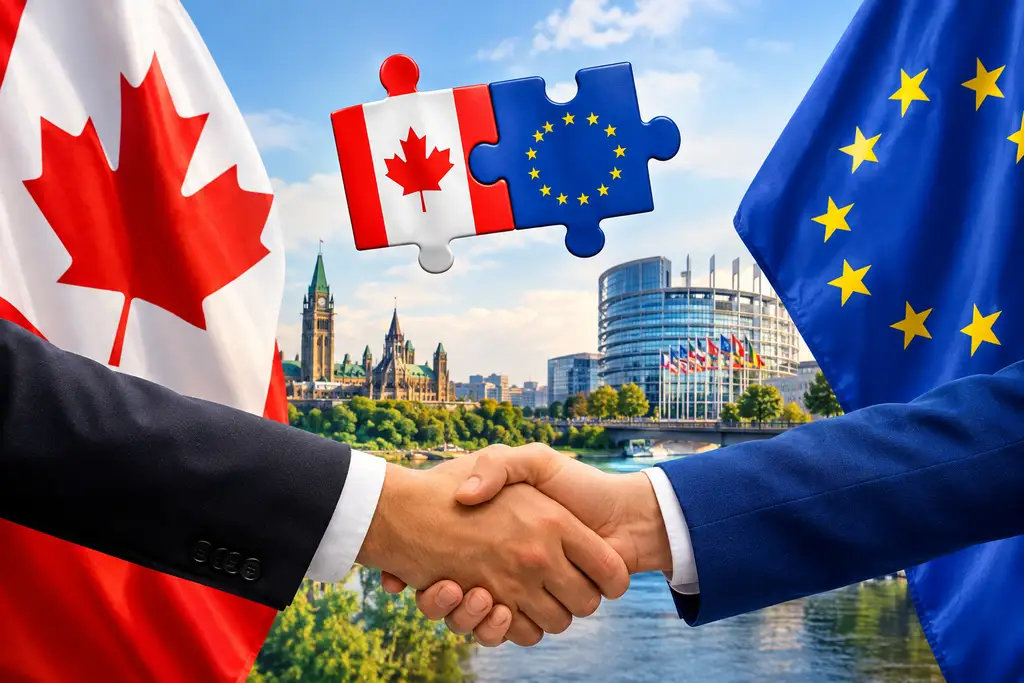
Roger-Luc Chayer (Image : AI / Gay Globe)
A major historic moment took place yesterday for Canada and Europe. For the first time in history, Canada was invited by the President of the European Commission, Ms. Ursula von der Leyen, during her State of the Union address, to open the door to an associated member status within the Union. An incredible slap in the face to the United States which, only a few weeks ago, wanted to strip Canada of its right to sign international agreements and treaties without the approval of the United States.
If this proposal from the European Union is accepted by Canada and becomes a reality, a new model of global economic and strategic partnership could emerge from this initiative. But what does this mean for Canada, for the European Union and for the United States?
Canada-Europe: What a Historic Association with the European Union Could Change
The invitation extended by European Commission President Ursula von der Leyen to Canada to become the European Union’s first associated member could mark a major turning point in the country’s international relations. And the speech delivered by Prime Minister Mark Carney before the European Parliament gives this new relationship a much more concrete dimension.
It is important, however, to be precise: Canada is not becoming a member of the European Union. The status of associated member does not yet exist in the European treaties, and its terms will have to be negotiated and approved. For the moment, therefore, this is a major political proposal that could lead to the creation of a new model of partnership between a non-European country and the EU.
Canada and Europe already have the Comprehensive Economic and Trade Agreement, CETA, but Mark Carney and Ursula von der Leyen now want to go much further. In his speech, Carney presented Canada and Europe as natural partners sharing common values, particularly democracy, the rule of law and the protection of human dignity.
The objective would be to build an alliance covering sectors considered strategic for the future on both sides of the Atlantic. Critical minerals, energy, defense, artificial intelligence, advanced computing, space, financial services, payments and digital trade are already among the areas identified by Ottawa and Brussels. The two sides also want to further develop trade in services and facilitate ties between their populations.
For Canada, the stakes are considerable. A much closer economic relationship with Europe would offer new opportunities to Canadian companies and could accelerate the diversification of trade.
Canadian Resources Could Become an Asset
Canada possesses resources that Europe is specifically seeking to secure supplies of: lithium, nickel, cobalt, uranium and other critical minerals, not to mention energy. Stronger cooperation could therefore encourage European investment in Canadian mining, energy and industrial sectors. It could also allow Canada to further develop value chains on its own territory rather than limiting itself to exporting raw resources.
Energy is also an important sector. Carney mentioned the possibility of Canada contributing more to European energy security, particularly through its energy capabilities and the development of new infrastructure.
The other particularly important dimension concerns defense. Canada and several European countries are already allies within NATO, but a much closer institutional relationship with the European Union could make it possible to develop more joint industrial projects.
The Canadian government is specifically referring to defense industrial capabilities, while von der Leyen has proposed further integrating European and Canadian industrial bases. Canada already participates in the European SAFE program dedicated to defense investment. The Arctic could also become a major joint project. Canada has a strategic geographic position in the Far North, while Europe is seeking to strengthen its capabilities in this region, which is expected to become increasingly important economically, energetically and in terms of security.
A New Door for Technology
Artificial intelligence, advanced computing, quantum computing, cybersecurity and space are also among the sectors likely to benefit from this new alliance. For Canadian companies and researchers, closer ties with Europe could mean greater access to research programs, capital, technological infrastructure and markets. The Canadian government is also presenting this cooperation as a means of increasing the country’s resilience and strategic autonomy.
What About Canadians Themselves?
The association could eventually have much more concrete consequences in everyday life. Ottawa and Brussels want to strengthen ties between their populations and provide citizens with more opportunities to travel, study and work on both sides of the Atlantic.
This does not, however, mean that Canadians would automatically benefit from European free movement. This would be one of the many elements to be negotiated in defining the future status of associated membership. The question will therefore be how far this association could go without turning Canada into a member of the European Union.
This is probably one of the most interesting aspects of the project. Mark Carney presents closer ties with Europe not as an abandonment of sovereignty, but as a way of strengthening Canada’s ability to act independently in an increasingly fragmented world. The idea is relatively simple: the more Canada has solid economic, technological, energy and military partners, the less it depends on a single partner.
The Extreme Reaction from the United States
The Canada-Europe rapprochement obviously comes in a context of trade and political tensions with Washington, while Trump realizes that everything he has attempted to do against Canada simply is not working and is turning against Americans themselves.
Donald Trump has already criticized the European proposal and once again threatened the European Union with trade consequences if it moved forward, despite the recent signing of a trade agreement that was supposed to prevent future sanctions. We already know that everything the President of the United States signs has a very limited lifespan, ranging from a few hours to a few months.
Carney, for his part, insists that Canada is seeking to strengthen its sovereignty and partnerships rather than build an alliance directed against the United States. Von der Leyen herself has presented the project as an association intended to strengthen common capabilities and not as an initiative directed against another country.
The paradox is obvious: the more Canada seeks to diversify its alliances, the more that diversification itself can become a major geopolitical issue. The real challenge begins now.
The European Union has never had a general category of associated member comparable to what has been proposed for Canada. It will therefore be necessary to determine what Canada’s rights would be, what its obligations would be, which European programs would be accessible to it and to what level its economy could be integrated into the European market. The Canada-European Union summit scheduled for Montreal in October should be an important step in this discussion.
If negotiations succeed, Canada could become the first non-European country to establish such a deep institutional relationship with the Union. It would therefore not be Canada joining Europe.
It would be something different: the creation of a new model of partnership between North America and Europe, based on trade, but also on defense, energy, technology, natural resources and a shared desire to strengthen their strategic autonomy.
Europe and Canada: Similar Social Recognitions
Among the sectors of civil society on both sides of the Atlantic that could derive significant benefits from this association, sexual minorities, particularly LGBT communities, occupy a special place. The same is true of social minorities in general. Canada and the European Union already share a relatively similar framework of rights and legal recognition on several of these issues.
Closer institutional ties could therefore promote better protection of rights, the harmonization of certain standards and, above all, provide additional guarantees to the people concerned. In a context where protections and rights may evolve differently in the United States, Canada could thus consolidate its own achievements by relying more heavily on a European partner whose legal frameworks are largely based on the same principles of protecting rights and freedoms.
ADSVERTISING

Read also
- What if Canada Turned Its Back on the United States to Join the European Union?
Read the article - Against Trump: A King to Protect Canada’s Sovereignty
Read the article - Trump on the Defensive: Is Mark Carney Winning the Economic War?
Read the article - Trump Wants to Punish Canada: America Will Pay
Read the article - Trump Faces Global Resistance: King Charles III Intervenes
Read the article - The King, Trump and FIFA: Diplomatic Humor and the French Language at the British Court
Read the article