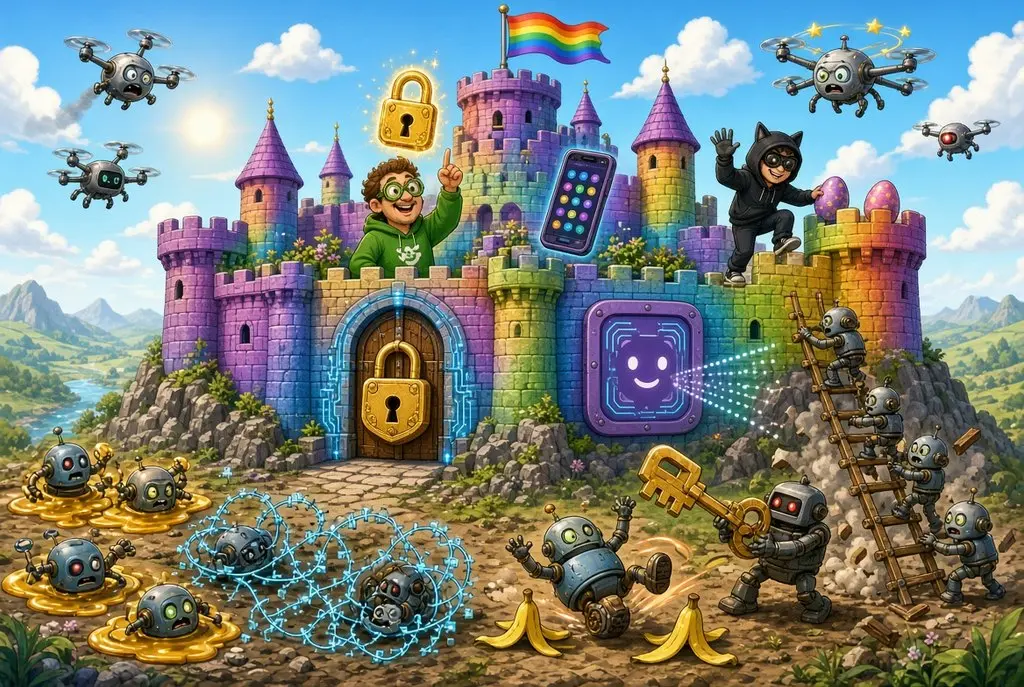
Roger-Luc Chayer (Image : AI / Gay Globe)
In an age of automated hacking bots and entire bot farms capable of launching billions of fraudulent attempts every day, no one is immune. From major banks to multinational corporations, from public services to small independent websites like Gay Globe, everyone is now exposed, to varying degrees, to constant attempts to break into their systems.
These attacks are not always carried out by an individual sitting behind a computer somewhere in the world. A large proportion of them are now automated, carried out by bots that scan the Internet looking for exploitable security vulnerabilities. In this environment, failing to properly protect a website, regardless of its size, is essentially like leaving the door wide open.
I know this from experience.
A few years ago, Gayglobe.net was essentially protected by nothing more than a simple password. One night, a hacker managed to gain access to the site without us realizing it immediately.
And it was the way he acted that really caught my attention. He could have deleted thousands of publications, altered our content, destroyed years of archives or caused considerable damage. He did none of that. Instead, he published two articles in English that had absolutely nothing to do with our usual content.
Two absurd, almost ridiculous articles that seemed more like deliberate warnings left on the site than an actual attempt to cause damage. Yet the message was very clear: “You have a security problem.” We got the message.
The very next morning, I even published a message addressed to the hacker, thanking him for making us aware of the weakness in our security and telling him that we would take the necessary steps to better protect Gayglobe.net. The first step was, obviously, to change the password.
Looking back, that intrusion, limited as it was, ultimately served as a kind of free warning. The hacker could have caused much more damage. Instead, he chose to show us that the door was open.
After researching the security standards of the time, we added a second layer of protection, on top of a much more complex and difficult-to-guess password. This is known as two-factor authentication (2FA). Two-factor authentication (2FA) adds a second way of verifying your identity in addition to your password. For example, after entering their password, users must confirm their identity with a code received by phone, an authentication app or a security key.
This means that even if a hacker manages to discover the password, they normally cannot access the account without the second factor.
In addition to these two measures, a third layer of protection was added. I will not discuss its nature, however, because it is an invisible security measure designed to block hacking attempts even if someone were able to crack our password and obtain the 2FA code, which changes automatically every minute.
An impenetrable wall? No. With artificial intelligence and the technologies available at the time this article is being published, it is still possible to bypass or defeat certain security measures protecting a website. That is precisely why Gay Globe implemented another security feature this morning.
It is called a “passkey,” an authentication technology designed to significantly strengthen account security by eliminating, among other things, the need to rely on traditional passwords.
Why Add Another Layer of Protection?
Even though our security software, Wordfence, provides strong protection against attacks and unauthorized access attempts, these attempts still number in the hundreds. We receive detailed reports on this activity every week.
For example, even though the day has barely begun, 21 intrusion attempts have already been detected today. Last week, Wordfence recorded 96 attempts, while the total for the past 30 days stands at 329. That is certainly no small matter.
Among these hundreds of attempts, the data collected indicates that more than 80% appear to have come from human activity, while the remainder came from automated bots.
It should be noted that the majority of attempts attributed to humans appear to originate in France. However, this information must be interpreted with caution: VPNs can hide the true IP address and, consequently, the actual location of the computer or person behind the access attempt.
In short, a “passkey” is essentially a new way of logging into a website without having to use a password. The system uses a cryptographic key that is stored on our device and cannot simply be obtained by a hacker.
In practical terms, instead of typing in a password, I simply confirm my identity using my device’s security system, such as Face ID, Touch ID, a PIN or the device’s own locking mechanism.
The advantage is that even if someone managed to obtain my old password, it would be useless to them because the passkey relies on a unique key linked to my device. It is therefore an additional layer of security that makes it much more difficult for hackers and bots to gain access to websites they are constantly trying to break into.
Why Is It Important to Protect Gayglobe.net?
Why is it so important to protect a website like Gayglobe.net? Because beyond simply keeping a website running, we have decades of journalistic work behind us, thousands of publications and archives that represent a genuine record of our media history.
A successful intrusion could allow a hacker to modify or delete articles, destroy archives, install malicious content or even take control of our accounts. It could also directly damage Gay Globe’s credibility if content were published in our name.
But the consequences would not stop there. Our readers could also be affected. A compromised website could redirect visitors to fraudulent pages, display malicious software, attempt to collect their personal information or simply cause them to lose trust in the site they are visiting. In some cases, an attack could even make the site completely inaccessible for several hours or several days.
It is also important to understand that a website like ours is constantly exposed to the Internet. Regardless of its size or number of visitors, it can be discovered and automatically targeted by bots searching for security vulnerabilities.
For us, protecting Gayglobe.net therefore means much more than simply protecting a website. It means protecting our work, our archives, our digital identity and, above all, the trust of our readers. After more than 30 years of journalism, it would be completely unacceptable to me to see all this work compromised by a security vulnerability that could have been prevented. And it would be equally unacceptable for our readers to unknowingly become collateral victims of an attack targeting our website.
ADVERTISING

READ ALSO
Let’s Have a Laugh: Analysis of Gay Globe by Artificial Intelligence (Gemini, ChatGPT, Grok, Claude)
Too Old for Social Media? Sorry, I Didn’t Know Facebook Had an Age Limit!
Certified Media: Gay Globe Strengthens Trust in the Face of Misinformation
How Can We Distinguish Fact from Fiction in News and Information?
Gay Globe Media’s New Web Pages Optimized for the Web
11,900 Articles Published: Gay Globe Reaches a New Historic Milestone