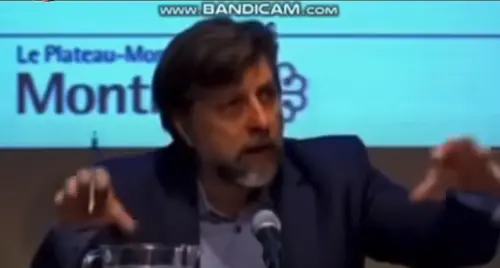
Roger-Luc Chayer (Image: Bandicam source, apparently originating from a Plateau-Mont-Royal borough council meeting)
Scandal and Harassment Against Montrealers and Quebec Motorists
One of the biggest scandals involving what many consider to be harassment of Montreal residents, and more broadly of Quebec motorists who drive through the metropolis, was revealed by the mayor of the Plateau-Mont-Royal borough during what appears to have been a borough council meeting. These remarks date back to the years when Mayor Valérie Plante and Projet Montréal, the same party as Mayor Luc Ferrandez, governed the city. According to their critics, they imposed a doctrine whose results are now visible throughout Montreal.
In Quebec, all vehicle drivers, regardless of the type of vehicle they own, pay registration fees and have the right to expect politicians, mayors, borough mayors, and federal and provincial elected officials to ensure that road infrastructure and traffic management are handled efficiently. Not only do they pay registration fees, but the vast majority also contribute to municipal taxes, whether they are homeowners or tenants.
According to the SAAQ, registration fees are charges required by the Société de l’assurance automobile du Québec to register a vehicle and allow it to operate legally on Quebec roads.
According to the City of Montreal, municipal taxes are used to finance services and infrastructure under the responsibility of the city and its boroughs. They contribute in particular to the maintenance and rehabilitation of local streets. More concretely, a significant portion of the city’s budget is devoted to the municipal road network: pavement maintenance, pothole repairs, signage, sidewalks, traffic lights, and underground infrastructure work beneath city streets. Municipal taxes also finance urban planning and mobility projects approved by the municipal administration.
Still according to the City of Montreal, expenditures directly attributable to the road network account for approximately 6.2% of the budget, to which part of snow removal, traffic signal operations, and certain infrastructure projects can be added. In other words, when a Montreal taxpayer pays municipal taxes, part of that money effectively goes toward streets, sidewalks, traffic lights, and maintenance of the road network.
Could this be any clearer?
However, during a Plateau-Mont-Royal borough council meeting, the exact date of which I do not know, Borough Mayor Luc Ferrandez outlined his vision, and his remarks were recorded. Here is the exact transcript of what he said, which you can also hear in the video available at https://gayglobe.net/Ferrandez26.mp4
“If we want to act, we have to fight climate change. We must discourage private car ownership, and we must discourage the use of cars downtown. And congestion is a solution. Making life difficult for motorists is one of the solutions.
So when we do this, we do it fully aware of what we are doing. We say to ourselves: we are going to remove cars from where they are most harmful, around parks and schools. Then they will go elsewhere. That elsewhere will become less comfortable. We have to narrow those streets. We have to make them tighter. We need speed bumps, we need more traffic lights. And after that, it still won’t be enough. We have to go even further.”
It is absolutely astonishing that an elected official would openly state a desire to make life more difficult for Montrealers, deliberately and knowingly, as he himself explained. Meanwhile, citizens pay their municipal taxes and vehicle registration fees believing that the mayor of Plateau-Mont-Royal and the other elected officials in his administration are working to improve their quality of life and promote smoother traffic flow throughout the metropolis, thereby contributing to a stronger economy and a better living environment.
Yet Mr. Ferrandez clearly did not see things that way.
Urban, Economic and Social Consequences of Municipal Policies
During one of his election campaigns, although I no longer remember the exact year, I encountered Mr. Ferrandez while he was meeting voters in the Plateau. He was standing in front of the Intermarché grocery store at the corner of Boyer and Mont-Royal streets while I was delivering magazines to the establishment and trying to find my way through a maze of one-way streets that seemed to lead nowhere. After my delivery, I stopped to speak with him.
I asked whether he could find a solution to improve traffic flow in his borough, explaining that to leave the area I either had to drive through alleys, which was not recommended, or travel against the intended traffic direction on certain streets in order to reach a boulevard and exit the district.
He listened very attentively and assured me that he would ask his officials to review traffic circulation and improve it. But it was election season, and more importantly, I was unaware of this video or of his actual plans. He was re-elected that year.
From a public perception standpoint, this type of language can be highly sensitive. Explicitly saying that “congestion is a solution” or that officials must “make life difficult for motorists” can be interpreted as a punitive approach rather than an urban planning strategy. Even if the stated objective is environmental protection or public safety, such wording can create the impression of conflict between elected officials and drivers, particularly in a context where many people still depend on their vehicles for everyday life.
From a democratic perspective, such statements raise a fundamental question: how far can elected officials go in attempting to change public behaviour without losing social support? A policy aimed at reducing automobile use may be coherent, but it generally requires strong alternatives—efficient public transit, accessibility, and regional consistency—or it risks being perceived as a one-sided constraint.
We are now aware of the consequences of Mr. Ferrandez’s policies, long after his departure from borough politics. These policies targeting motorists have, according to this interpretation, contributed to human, economic, and social consequences for Montreal, especially since the city’s mayor at the time belonged to the same political party.
Because of a doctrine focused primarily on imposing constraints on motorists, his former borough and the City of Montreal as a whole face significant challenges that stem from years of policies that, according to critics, prioritized certain urban planning objectives over the economic and social well-being of Montrealers.
A pothole crisis that the current administration struggles to address because of chronic underinvestment in maintenance and the prioritization of curb extensions, speed bumps, and street narrowing projects rather than road upkeep. A housing crisis, with Montrealers living in large encampments, something rarely seen in previous decades. A growing homelessness crisis, with vulnerable individuals having been neglected for years. A public transit crisis, as the STM faces substantial and difficult-to-resolve financial deficits.
Montreal is not experiencing a single crisis but rather a series of overlapping social and economic pressures that reinforce one another.
The most visible is the housing crisis. Rents have risen sharply in recent years, vacancy rates remain low, and the supply of affordable housing is insufficient. This pressure affects low-income households and the middle class alike, directly contributing to other social challenges.
At the same time, homelessness is increasing throughout the metropolis. It is driven primarily by housing accessibility issues, but also by mental health and addiction challenges, as well as the saturation of shelter resources. This has resulted in a more visible homeless population in certain public spaces.
Economically, many households face mounting pressure from the cost of living. Inflation, rising rents, and higher interest rates have significantly reduced the financial flexibility of a large segment of the population.
Another major challenge concerns urban infrastructure. Aging roads and underground infrastructure generate substantial maintenance costs and frequent construction projects, affecting mobility and the overall perception of quality of life in the city.
Public transit is also under pressure. The network remains essential to the functioning of the metropolis but faces significant funding and modernization needs at a time when travel patterns continue to evolve following the pandemic.
Was making life more difficult for motorists really the priority, considering what the city has become?
Today, Luc Ferrandez primarily works as a columnist and radio host at 98.5 FM Montreal, where he serves as a political and municipal affairs commentator and analyst.
Since leaving municipal politics, he has held no elected office. His public activities are now focused mainly on the media, where he participates in news and debate programs, particularly on urban, environmental, and political issues affecting Montreal and Quebec.
He may also occasionally appear as an analyst in other media settings, but his principal role today remains that of a media personality and commentator.
In my opinion, his current role as a journalist and commentator is incompatible with his political past. The judgment is yours.
ADVERTISING

READ ALSO
International Aid and LGBTQ+ Rights: The Paradox of Countries Receiving Funding Despite Anti-Homosexuality Laws
https://gayglobe.net/en/international-aid-and-lgbtq-rights-the-paradox-of-countries-receiving-funding-despite-anti-homosexuality-laws/
Iran: the execution of Saleh Mohammadi raises many unanswered questions
https://gayglobe.net/iran-the-execution-of-saleh-mohammadi-raises-many-unanswered-questions/
How Oregon, Portugal, and Canada Handle Drug Decriminalization: What You Need to Know
https://gayglobe.net/how-oregon-portugal-and-canada-handle-drug-decriminalization-what-you-need-to-know/
Rob Jetten: The Young and Bold Face Redefining Dutch Politics
https://gayglobe.net/rob-jetten-biography-climate-lgbt/
Why does the housing crisis continue when simple solutions exist?
https://gayglobe.net/why-does-the-housing-crisis-continue-when-simple-solutions-exist/
Matthew Shepard’s Murderers, Twenty-Five Years Later: Justice Remains Unyielding
https://gayglobe.net/matthew-shepards-murderers-twenty-five-years-later-justice-remains-unyielding/
When Shelters Become a Shock: A Deep Dive into the Reality of Homelessness in Montreal
https://gayglobe.net/en/when-shelters-become-a-shock-a-deep-dive-into-the-reality-of-homelessness-in-montreal/
Analysis of Gay Globe by Artificial Intelligence: Gemini, ChatGPT, Grok and Claude Review GayGlobe.net
https://gayglobe.net/en/lets-have-a-laugh-analysis-of-gay-globe-by-artificial-intelligence-gemini-chatgpt-grok-claude/
Bad Bunny: Global Icon and Ally of LGBT Communities
https://gayglobe.net/en/bad-bunny-global-icon-and-ally-of-lgbt-communities/
Gay Globe Magazine – Canadian LGBTQ+ Media Since 1998
https://gayglobe.net/about/