
Roger-Luc Chayer (Photo : Matthew Shepard – Matthew Shepard Foundation)
A Look Back at the Story of a Heinous Murder
Following yesterday’s publication by Gay Globe Média of a short message announcing the anniversary of the death of Matthew Shepard, a victim of torture inflicted by two homophobic murderers on October 12, 1998, thousands of reactions followed.
In just 24 hours, there were 27,118 interactions with this publication on Gay Globe’s Facebook page as well as on the Village Montréal Officiel group (https://www.facebook.com/groups/1503518353310314), also managed by Gay Globe. Requests to join the page are now coming in every second from all over the world.
Unprecedented: such mobilization illustrates the reaction of an entire society to the horror suffered by Matthew Shepard, beaten, tortured, and then left for dead, tied to a fence in a Wyoming field, before succumbing to his injuries in the hospital.
This sordid murder was committed by two young homophobic men, Russell Henderson and Aaron McKinney.
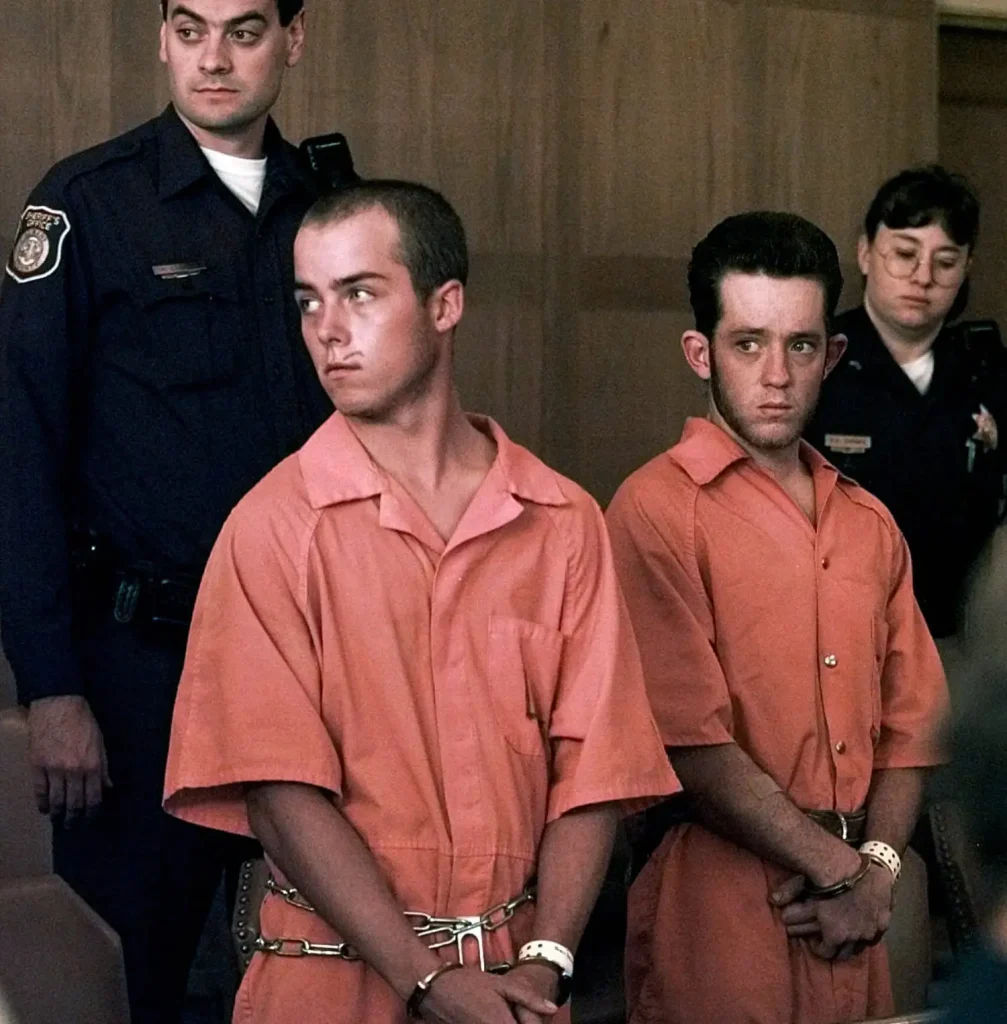
Russell Henderson and Aaron McKinney at their trial (Photographer: Ed Andrieski / AP)
The Trials
The investigation into the murder of Matthew Shepard began in a climate of emotion and outrage as soon as the young man was found, seriously injured, tied to a fence in the isolated plains of Wyoming, on the outskirts of Laramie, during the night of October 6–7, 1998. Police, called to the scene after a cyclist initially thought he had seen a scarecrow, quickly realized they were facing a crime of rare brutality. Matthew, a 21-year-old student at the University of Wyoming, was in a coma, his face bruised and barely recognizable.
The first hours of the investigation were crucial. Law enforcement quickly established that Shepard had last been seen at a bar in Laramie, the Fireside Lounge, where he had spent the evening talking with two men, Russell Henderson and Aaron McKinney. Witnesses confirmed that the three had left the bar together, and that Shepard had seemed to trust them. Investigators followed this lead until they found the suspects’ pickup truck, in which they discovered the victim’s wallet and ID cards, as well as traces of blood. This discovery allowed the two men, who lived in a modest neighborhood of the town, to be formally identified.
The arrests took place quickly, less than 24 hours after the events. Henderson and McKinney were apprehended without resistance after a young woman, the partner of one of them, provided decisive information to authorities. The two suspects initially tried to minimize their involvement, claiming that the assault was merely a robbery gone wrong. But the material evidence, the violence of the beating, and the homophobic statements made before and after the crime convinced investigators that it was an act motivated by hatred.
Over the following months, the small town of Laramie was plunged into a climate of introspection and tension. National media poured in, residents were divided between shame, anger, and incomprehension, while the American LGBT community made Shepard’s tragedy a symbol of the fight against hate crimes.
When the trials began, the defense’s strategy was to present the accused as immature young men, influenced by drugs and alcohol, seeking to partially excuse themselves by invoking “gay panic,” an argument still pleaded in some jurisdictions at the time. The court rejected this thesis, considering that no provocation could justify the barbarity of the acts committed.
Russell Henderson chose to plead guilty to avoid the death penalty. He was sentenced to two life sentences without the possibility of parole. Aaron McKinney, tried separately, attempted to convince the jury of diminished responsibility, but the facts were overwhelming: testimonies, forensic evidence, and reenactments revealed a scene of unprecedented violence. Given the severity of the crime, the jury also found full and complete guilt. After negotiations with the Shepard family, concerned about avoiding an execution that would only perpetuate hatred, the prosecution waived the death penalty. McKinney was also sentenced to life imprisonment without the possibility of parole.
The Shepard case profoundly marked the United States and transformed public debate on hate crimes. More than a decade later, it led to the adoption of the Matthew Shepard and James Byrd Jr. Hate Crimes Prevention Act, enacted in 2009, which extends the federal definition of hate crimes to those based on sexual orientation and gender identity.
Today, Russell Henderson and Aaron McKinney are still serving their sentences in Wyoming correctional facilities.
Request for Sentence Reduction by Russell Henderson
In 2024, one of Matthew’s murderers requested early release from the court. More than twenty-five years after the tragedy, the case continues to echo in the corridors of Wyoming justice. Russell Henderson, one of Matthew Shepard’s two murderers, recently requested a commutation, hoping to see his double life sentence reduced. But the Wyoming Board of Parole rejected his request, confirming that he will remain behind bars for at least five more years.
Henderson, now in his forties, has already served twenty-five years in prison for one of the most heinous crimes in recent American history. According to Margaret White, Executive Director of the Board, the body examined the request in accordance with its policies before deciding not to forward it to the governor, which ends the process.
Wyoming law allows inmates serving life sentences to submit a commutation request — that is, a sentence reduction — every five years, provided they have already served at least ten years of incarceration. It is unknown whether Henderson had previously submitted such a request, but this is not the first time he has sought leniency. In 2004, through his attorney, he filed a post-conviction review request, claiming he had not been properly informed of his appeal rights when he entered his guilty plea. That attempt, like the most recent one, was also denied.
Thus, more than a quarter of a century after Matthew Shepard’s murder, Wyoming justice remains firm: no leniency will be granted to those who committed this act of unprecedented brutality.
ADVERTISING
