Roger-Luc Chayer ( Image : Explode / Shutterstock)
Hepatitis B: A Often Silent Viral Liver Infection
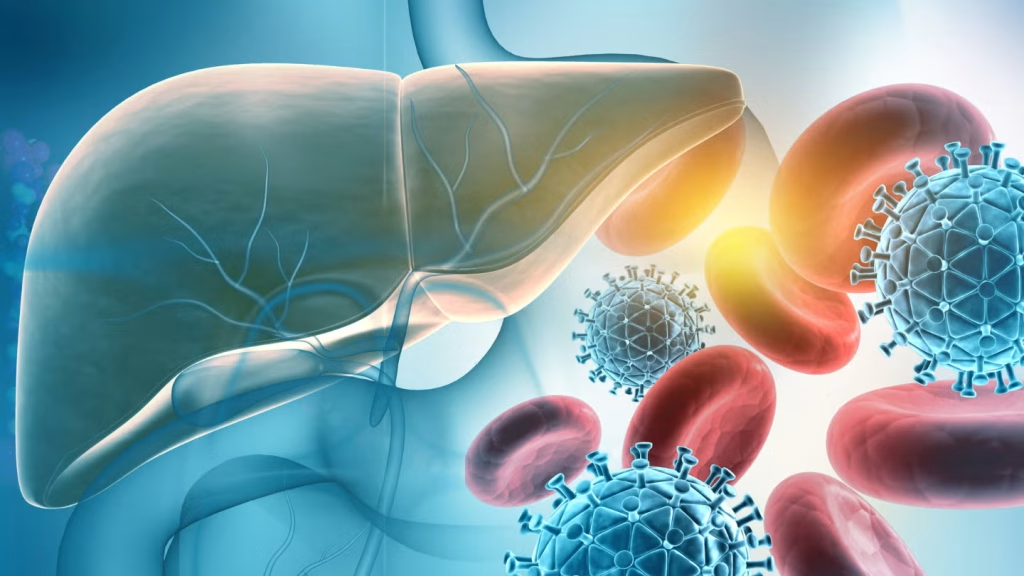
Hepatitis B is a liver infection caused by a virus that is widespread worldwide, often unknown because it can develop silently for a long time. This virus attacks the liver, an essential organ responsible for filtering blood, storing energy, and aiding digestion. When infected, the liver can become inflamed, sometimes without causing immediate symptoms, which explains why many people do not know they carry it.
Transmission of Hepatitis B: How the Virus Spreads
Hepatitis B transmission occurs mainly through contact with contaminated blood or bodily fluids. It can happen during unprotected sexual relations, sharing injection equipment, or during unsafe medical procedures. Contrary to some misconceptions, it is not transmitted through everyday gestures like shaking hands, kissing, or sharing a meal.
Acute and Chronic Hepatitis B
In some cases, the body can naturally eliminate the virus after a few months. But when the infection persists, it is called chronic hepatitis B. This form can, over time, lead to serious complications such as cirrhosis or liver cancer, which highlights the importance of screening even in the absence of visible signs. Persistent fatigue, jaundice, or abdominal pain may appear, but they are neither constant nor systematic.
Why Gay Men Are More Affected
If gay men are statistically more affected by hepatitis B, it is neither a matter of sexual orientation itself nor a biological fatality, but the result of several social, medical, and historical factors that have combined over time. The hepatitis B virus spreads very effectively through sexual transmission, and certain practices, particularly unprotected anal sex, expose individuals to micro-lesions that facilitate the virus’s entry into the body. This mechanically increases the risk of transmission when the virus circulates within a given network.
Adding to this is a well-known epidemiological reality in public health: when an infection is more prevalent in a specific group, each new exposure within that group carries a higher risk. For decades, gay men have been insufficiently targeted by prevention campaigns outside of HIV, and many discovered their hepatitis B status late, sometimes by chance during medical check-ups. This invisibility has helped maintain the silent circulation of the virus.
It is also important to remember that older generations of gay men did not always benefit from the vaccine, which was only widely introduced from the 1990s in many countries. Before that, hepatitis B was common in urban gay communities, often associated with other sexually transmitted infections, in a context where access to information and care was sometimes limited or affected by discrimination.
Hepatitis B Vaccination: An Effective Strategy
In Western countries, hepatitis B vaccination was offered from the 1990s, often free of charge, specifically targeting gay men to curb the spread of the virus, and this strategy has worked very well. The protection provided by the vaccine is long-lasting. In my case, for example, I was vaccinated in 1997, and during a control and screening blood test in 2020, a good presence of antibodies was still detectable, indicating that my protection was still ensured.
When Hepatitis B Becomes Chronic
Hepatitis B is not systematically chronic, but it can become so in certain cases. When a person is infected in adulthood, the immune system most often manages to eliminate the virus spontaneously within a few months. The infection is then called acute and resolves without leaving lasting sequelae, with immunity acquired thereafter.
Conversely, when the virus persists beyond six months, it is called chronic hepatitis B. This situation is more common in people infected very early in life, especially at birth or during early childhood, because their immune system is less capable of controlling the virus. The chronic form can evolve slowly and remain asymptomatic for a long time, while progressively causing liver damage.
Medical Research: New Hope Against Hepatitis B
Good news: medical research is advancing faster than ever on many fronts, and regarding hepatitis B, a new experimental drug shows promising preliminary results.
Bepirovirsen, a Promising Experimental Treatment
According to GSK, an international pharmaceutical company, chronic hepatitis B is today a major global public health challenge. It affects more than 250 million people and is the leading cause of liver cancer worldwide. Current treatments mainly rely on nucleos(t)ide analogues, which control viral replication but often require lifelong use. Despite their effectiveness in slowing the disease, these treatments rarely lead to what is called a functional cure, with rates generally not exceeding 1%. Functional cure corresponds to a situation where the virus is no longer detectable in the blood, with a sustained disappearance of hepatitis B surface antigen and undetectable viral load for at least 24 weeks after a finite course of treatment. This situation allows the immune system to control the infection without continuous medication and significantly reduces the risk of liver complications and mortality.
It is in this context that the B-Well clinical trials have attracted major interest. These studies showed that bepirovirsen achieved statistically significant and clinically meaningful functional cure rates, clearly superior to standard treatment alone. The results were particularly marked in patients with a lower baseline surface antigen level. The observed safety and tolerability profile is considered acceptable and consistent with previous studies.
According to Tony Wood, Chief Scientific Officer at GSK, bepirovirsen could transform therapeutic goals for people living with chronic hepatitis B. For the first time, a treatment demonstrates the ability to induce significant functional cure rates. If approved by regulatory authorities, bepirovirsen could become the first limited-duration treatment, administered over six months, opening the way to a new era in the management of chronic hepatitis B.
ADVERTISING