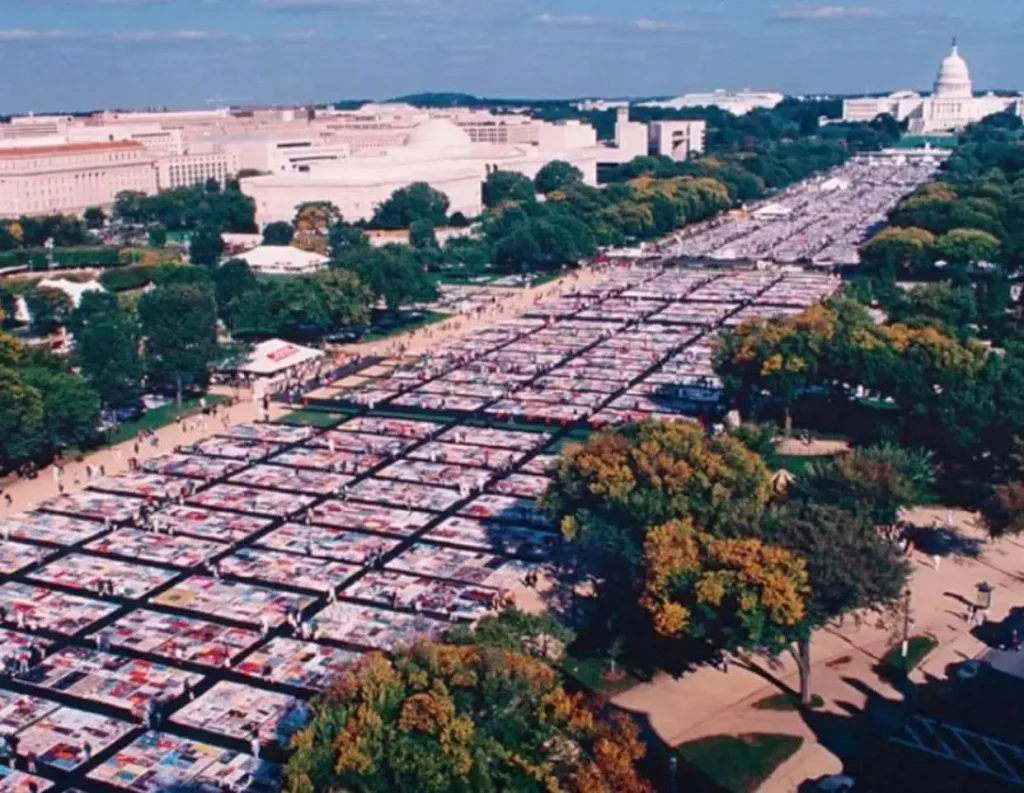
Roger-Luc Chayer& Carle Jasmin (Photo : NAMES Project AIDS Memorial Quilt)
The impact of AIDS on gay men worldwide
People have been talking about it for years: AIDS has caused incalculable devastation over time, and it is estimated that around 30% of gay men have died from it in Western countries alone, not even counting the millions of deaths recorded in Africa, China, Russia, or Asia.
Living with HIV: a reality long marked by suffering
It is also necessary to address the tens of millions of people living with the HIV virus, which for a long time severely affected their quality of life, until a more recent period when medical research turned toward much lighter treatments, now making it possible to live longer and in far better conditions.
Social backgrounds of gay men who died of AIDS
Gay men who died of AIDS came from all segments of society, with no clear distinction of social class, origin, or level of education, even though public perception was long distorted by stereotypes. At the beginning of the epidemic, in the 1980s, the first visible cases often involved urban gay men, sometimes artists, intellectuals, or individuals from relatively privileged backgrounds, simply because they had greater access to healthcare, media, and community networks capable of documenting the disease.
An epidemic that also affected the most marginalized
But very quickly, AIDS also affected gay men from working-class backgrounds, rural areas, immigrant communities, and people who were precarious, isolated, or marginalized, whose deaths were often less publicized and sometimes even kept silent because of shame, family rejection, or pervasive homophobia.
Before triple therapy: the scale of devastation
But an image is worth a thousand words. The photo above illustrates the horror of devastation at a time when triple therapy had not yet been invented or made available to people living with HIV. In the United States, in order to give a face to a reality that was still rarely discussed, activist Cleve Jones decided, in 1985, to launch the AIDS Memorial Quilt.
The AIDS Memorial Quilt: collective memory of AIDS
The AIDS Memorial Quilt is a collective commemorative work created to honor people who died of AIDS and to break the silence surrounding the epidemic. This monumental quilt is made up of thousands of fabric panels, each dedicated to a person who has passed away, created by loved ones, friends, or grieving communities. Each panel bears a name, sometimes a message, photos, or personal objects, transforming individual memory into a public and deeply human memory. First presented in 1987 in Washington, the quilt struck consciences with its scale and emotional power.
A unique artistic and memorial project in the world
Each 3-foot by 6-foot panel (approximately 0.9 m by 1.8 m) commemorates a life lost, making it the largest community art project in the world.
An image that became a political and human symbol
This photo shows the staggering scale of the AIDS Memorial Quilt displayed on the National Mall in Washington, facing the Capitol, and above all symbolizes the unimaginable number of lives claimed by AIDS. Each visible fabric rectangle represents a person who died from the disease, a name, a story, a family, and together they transform an abstract number into a physical reality impossible to ignore.
Political silence and marginalized populations
The choice of this location, at the heart of American political power, is far from incidental: the image directly confronts the state and society with their silences, delays, and indifference in the face of a public health crisis that was long minimized because it largely affected marginalized populations, notably gay men.
A memory that remains alive
Seen from above, this sea of panels evokes both a cemetery without graves and an act of peaceful protest, reminding us that behind every statistic lies a loved life, and that the AIDS epidemic was never an abstraction but a massive and very real human tragedy.
What became of the AIDS Memorial Quilt
The AIDS Memorial Quilt never disappeared after its initial impact, but evolved over time. After being displayed repeatedly in Washington and in many cities around the world, the project became a living and traveling work, continually enriched with new panels over the years.
The NAMES Project Foundation and the transmission of memory
It is now preserved and managed by the NAMES Project Foundation, which ensures its preservation, archiving, and circulation through exhibitions, commemorative events, and educational programs. Although the quilt is no longer displayed in its entirety as it was in the 1980s and 1990s, due to its immense size and logistical constraints, it remains a central symbol of AIDS memory, essential for passing on the history of the epidemic to new generations and for reminding us that, despite medical advances, human losses and the fight against stigma must never be forgotten.
ADVERTISING