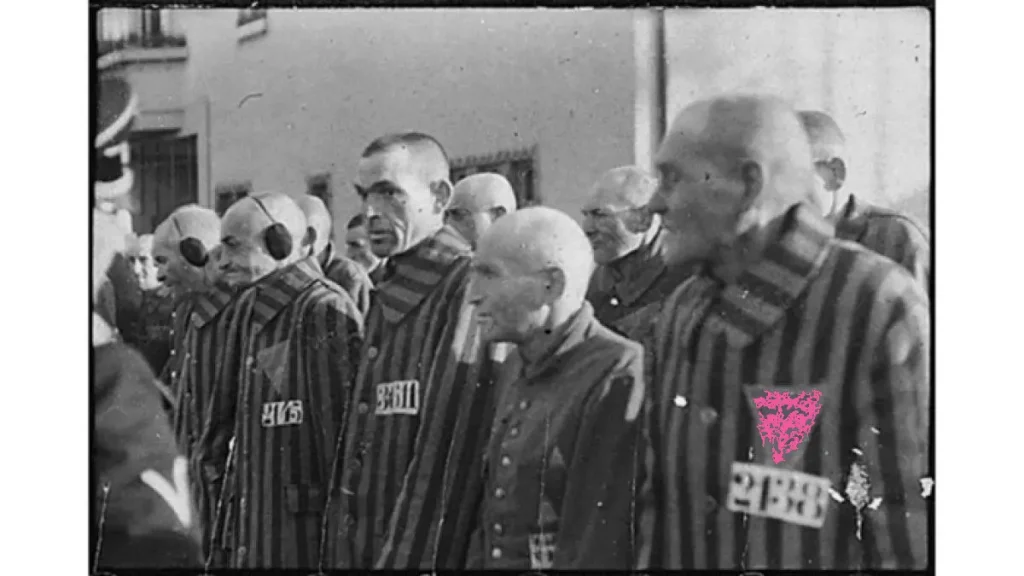
Roger-Luc Chayer (Photo : NARA – National Archives and Records Administration)
On entend souvent les plus jeunes parler d’extrême droite, d’extrême gauche, de fascistes ou de nazis, se traitant les uns les autres de tous ces termes sans vraiment savoir ce qu’ils signifient, et surtout ce qu’ils représentent pour les gays et les lesbiennes.
Les termes de fasciste et de nazi sont particulièrement populaires sur les réseaux sociaux, mais savent-ils réellement ce qu’ils signifient, à part propager leur propre haine ?
Qu’est-ce que le fascisme ?
Le fascisme est une idéologie politique autoritaire et nationaliste qui repose sur le pouvoir absolu d’un État fort, dirigé par un chef unique, et sur la suppression des libertés individuelles. Né en Italie au début du XXe siècle, il est étroitement associé à Benito Mussolini, qui a instauré un régime dictatorial fondé sur le contrôle de la société, la propagande et la répression des opposants.
Le fascisme valorise l’unité nationale au détriment des différences, rejette la démocratie libérale et encourage souvent la censure, la militarisation et la glorification de la nation. Il s’accompagne fréquemment de persécutions envers les minorités et ceux qui ne correspondent pas à l’idéologie dominante.
Ce type de régime a également inspiré d’autres systèmes autoritaires, notamment celui de Adolf Hitler en Allemagne, bien que le nazisme comporte des caractéristiques propres, notamment un racisme systématique et une idéologie antisémite extrême.
Qu’est-ce que le nazisme ?
Le nazisme est une idéologie politique totalitaire développée en Allemagne au début du XXe siècle, principalement associée à Adolf Hitler et au parti nazi. Il s’agit d’une forme extrême de nationalisme qui combine dictature, culte du chef, propagande et contrôle total de la société.
Au cœur du nazisme se trouve une idéologie raciste et antisémite, fondée sur la croyance en la supériorité d’une prétendue « race aryenne ». Cette vision a conduit à des politiques de persécution, d’exclusion et d’extermination de millions de personnes, notamment lors de la Holocauste.
Le régime nazi rejetait la démocratie, supprimait les libertés individuelles et utilisait la violence ainsi que la peur pour maintenir son pouvoir. Il a également joué un rôle central dans le déclenchement de la Seconde Guerre mondiale, l’un des conflits les plus meurtriers de l’histoire.
Quelles ont été les exactions du nazisme contre les homosexuels ?
Sous le régime nazi dirigé par Adolf Hitler en Allemagne, les homosexuels — en particulier les hommes — ont été violemment persécutés au nom d’une idéologie qui considérait l’homosexualité comme une menace pour la « pureté » et la reproduction de la nation.
Dès les années 1930, le paragraphe 175 du code pénal allemand a été renforcé afin de criminaliser encore plus sévèrement les relations entre hommes. Des dizaines de milliers d’entre eux ont été arrêtés, emprisonnés ou condamnés. On estime qu’entre 5 000 et 15 000 homosexuels ont été envoyés dans des camps de concentration, où ils étaient identifiés par un triangle rose cousu sur leurs vêtements.
Dans ces camps, ils subissaient des conditions particulièrement brutales : travaux forcés, violences physiques, humiliations, expérimentations médicales et exécutions. Leur taux de mortalité était extrêmement élevé, en raison des mauvais traitements et de leur isolement, y compris de la part d’autres détenus.
Ces persécutions s’inscrivent dans le cadre plus large des crimes du nazisme, notamment durant la Seconde Guerre mondiale et la Holocauste. Pendant longtemps, les victimes homosexuelles ont été oubliées ou peu reconnues, et ce n’est que plusieurs décennies plus tard que leur mémoire a commencé à être officiellement honorée.
Le triangle rose : une mémoire souvent méconnue
Voilà donc l’origine du fameux triangle rose que les LGBT arborent le plus visiblement possible, sans vraiment savoir qu’il s’agissait à l’origine d’un symbole nazi utilisé pour persécuter et exécuter les homosexuels. Quand on ne connaît pas son passé, on a tendance à le répéter, demandez à Donald Trump !
PUBLICITÉ / ADVERTISING

We often hear younger people talking about the far right, the far left, fascists or Nazis, throwing these terms at each other without really knowing what they mean—especially what they represent for gay men and lesbians.
The terms fascist and Nazi are particularly popular on social media, but do they really understand what they mean, beyond spreading their own hatred?
What is Fascism?
Fascism is an authoritarian and nationalist political ideology based on absolute state power, led by a single leader, and on the suppression of individual freedoms. It emerged in Italy in the early 20th century and is closely associated with Benito Mussolini, who established a dictatorial regime built on social control, propaganda, and the repression of opponents.
Fascism promotes national unity at the expense of diversity, rejects liberal democracy, and often encourages censorship, militarization, and the glorification of the nation. It is frequently accompanied by the persecution of minorities and those who do not conform to the dominant ideology.
This type of regime also inspired other authoritarian systems, notably that of Adolf Hitler in Germany, although Nazism has its own characteristics, particularly systematic racism and extreme antisemitism.
What is Nazism?
Nazism is a totalitarian political ideology developed in Germany in the early 20th century, primarily associated with Adolf Hitler and the Nazi Party. It is an extreme form of nationalism combining dictatorship, a cult of leadership, propaganda, and total control of society.
At the core of Nazism lies a racist and antisemitic ideology, based on the belief in the superiority of a supposed “Aryan race.” This worldview led to policies of persecution, exclusion, and the extermination of millions of people, particularly during the Holocaust.
The Nazi regime rejected democracy, suppressed individual freedoms, and used violence and fear to maintain power. It also played a central role in triggering World War II, one of the deadliest conflicts in history.
What Were the Nazi Atrocities Against Homosexuals?
Under the Nazi regime led by Adolf Hitler in Germany, homosexuals—particularly men—were violently persecuted under an ideology that viewed homosexuality as a threat to the “purity” and reproduction of the nation.
Beginning in the 1930s, Paragraph 175 of the German penal code was strengthened to further criminalize relations between men. Tens of thousands were arrested, imprisoned, or convicted. It is estimated that between 5,000 and 15,000 homosexuals were sent to concentration camps, where they were identified by a pink triangle sewn onto their clothing.
In these camps, they faced especially brutal conditions: forced labor, physical violence, humiliation, medical experimentation, and executions. Their mortality rate was extremely high due to mistreatment and isolation, even from other prisoners.
These persecutions were part of the broader crimes of Nazism, particularly during World War II and the Holocaust. For a long time, homosexual victims were forgotten or barely acknowledged, and it was only decades later that their memory began to be officially recognized.
The Pink Triangle: A Often Misunderstood Symbol
This is the origin of the famous pink triangle that LGBTQ people display as visibly as possible, often without knowing that it was originally a Nazi symbol used to persecute and execute homosexuals. When we do not understand our past, we tend to repeat it—just ask Donald Trump!
PUBLICITÉ / ADVERTISING
LIRE AUSSI / READ ALSO
📄 Article en français
Titre : La vie homosexuelle en Italie fasciste
Description : Cet article explore l’histoire de l’homosexualité sous le régime fasciste en Italie, et comment les lois et la répression ont affecté la vie des personnes LGBTQ+.
Lien : https://gayglobe.net/la-vie-homosexuelle-en-italie-fasciste
📄 Article en anglais
Title: Homosexuality in Prehistory and Queer Archaeology: What Do Historical Evidence Really Say?
Description: This article examines the existence and expression of homosexuality throughout ancient history, discussing archaeological evidence and interpretations of sexual practices before the modern era.
Link: https://gayglobe.net/homosexuality-in-prehistory-and-queer-archaeology-what-do-historical-evidence-really-say