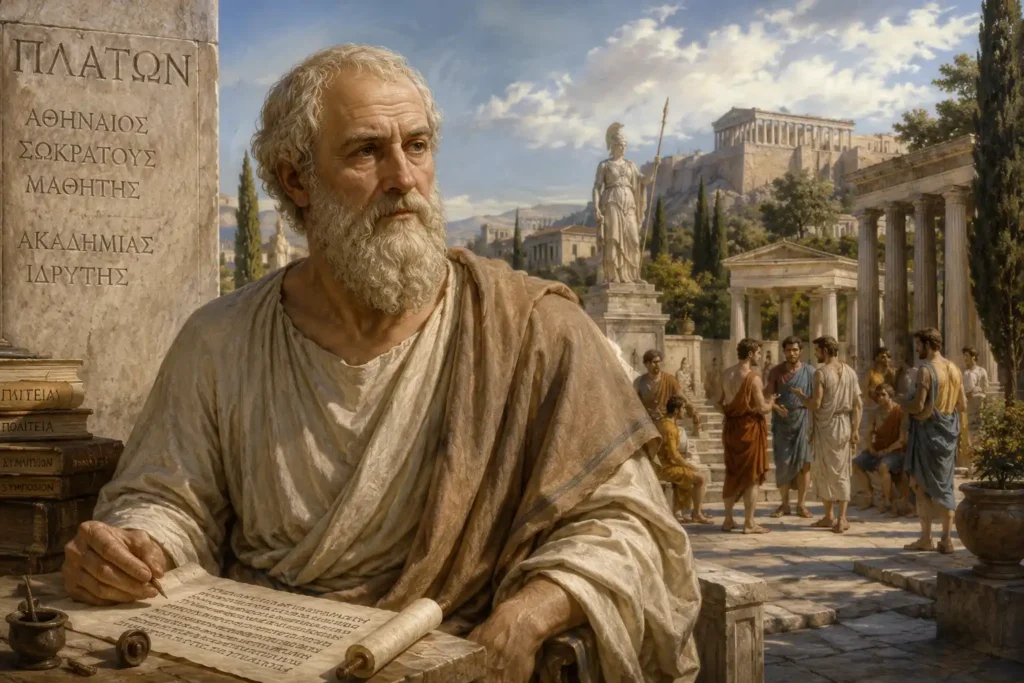
Arnaud Pontin (Image : AI / Gay Globe)
When asking which figure from Ancient Greece has had the greatest influence on philosophical thinking about same-sex love, and more broadly on the history of LGBT people, the name Plato frequently appears in academic research. But who was Plato, and how did he shape our modern understanding of love, regardless of the gender of those involved?
Plato: The Philosopher Who Shaped Western Thought
Plato is widely regarded as one of history’s greatest philosophers. Born around 428 or 427 BCE in Athens into an aristocratic family, he profoundly influenced philosophy, politics, ethics, and the understanding of love. More than 2,400 years after his death, his writings continue to be studied in universities around the world.
As a young man, Plato became a disciple of Socrates, whose teachings transformed his worldview. When his mentor was sentenced to death in 399 BCE on charges of corrupting Athenian youth and impiety, Plato was deeply affected. The event would shape his lifelong reflections on justice, political power, and the role of the state.
Following the death of Socrates, Plato traveled extensively, including journeys to Egypt and southern Italy, where he encountered other philosophical and scientific traditions. Upon returning to Athens around 387 BCE, he founded the Academy, widely regarded as the first major institution of higher learning in the Western world. For nearly nine centuries, the Academy educated generations of thinkers, including Aristotle, who would become one of history’s most influential philosophers.
Unlike many writers of his time, Plato presented his ideas in the form of dialogues. Socrates is often the central character, questioning others in order to explore truth, justice, knowledge, happiness, and politics.
Among Plato’s best-known works are The Republic, which presents his vision of the ideal state; Symposium, devoted to the nature of love; Phaedo, exploring the immortality of the soul; and Timaeus, discussing the origin of the universe.
In Symposium, Plato brings together several speeches about love. The discussions address both relationships between men and the broader meaning of love itself. Although these texts reflect the values of Ancient Greece rather than modern concepts of sexual orientation, they have profoundly influenced philosophical thought on love, desire, beauty, and human relationships.
Plato also developed the famous Theory of Forms, according to which the world we perceive consists of imperfect copies of eternal and perfect realities. This concept shaped philosophy, theology, science, and Western thought for more than two millennia.
How Did Plato View Same-Sex Love?
Unlike modern understandings of sexual orientation, Plato did not speak of “homosexuality” in the contemporary sense. In Ancient Greece, relationships between people of the same sex were viewed through social, educational, and cultural norms very different from those of today.
It is in Symposium, written around 385 BCE, that Plato presents his most influential reflections on love. The work consists of a series of speeches delivered during a banquet, where several participants attempt to define the true nature of love, or Eros.
One of the most famous speeches is delivered by Aristophanes, who recounts the myth that human beings were once composed of two joined bodies. Fearing their strength, the gods split them apart, leaving each person to search for their lost half. According to this story, some seek a partner of the opposite sex, while others are naturally drawn to someone of the same sex. Although this myth does not necessarily represent Plato’s own views, it remains one of the earliest philosophical explanations of the diversity of human attraction in Western literature.
Socrates, recounting the teachings of the priestess Diotima, offers a more philosophical understanding of love. Love should not end with physical attraction but should gradually lead individuals toward the contemplation of beauty, wisdom, and the good. In this vision, love becomes an intellectual and spiritual journey that transcends physical desire.
Plato does not explicitly condemn relationships between men, which were relatively common within certain circles of Classical Greece. However, he argues that genuine love should be guided by the pursuit of virtue, knowledge, and the perfection of the soul rather than by physical pleasure alone.
In his final political work, Laws, Plato adopts a more restrained approach toward sexual relationships in general, emphasizing self-control and the regulation of desire for the benefit of society. Historians continue to debate how much his views evolved between Symposium and his later writings.
The influence of Plato on Western thought has been immense. His works inspired philosophers, theologians, and scholars for more than two thousand years. Although his writings cannot be interpreted as a modern defense of LGBT rights, they opened an enduring philosophical discussion about the diversity of love and the possibility that same-sex love could be associated with beauty, virtue, wisdom, and truth.
Was Plato Gay?
No reliable historical document allows scholars to conclude that Plato was gay, straight, or bisexual.
It is also important not to impose modern concepts of sexual orientation on Ancient Greece. The categories of “homosexual” and “heterosexual,” understood as fixed personal identities, did not emerge until the nineteenth century. During Plato’s lifetime, relationships were generally understood in terms of age, social status, cultural context, and social roles rather than permanent sexual orientation.
Several aspects of Plato’s writings continue to fuel scholarly debate.
In Symposium, he describes emotional and intellectual relationships between men without condemnation, reflecting practices found among certain Athenian elites. Through several speakers, he even presents love between men as capable of leading individuals toward virtue, wisdom, and the elevation of the soul.
At the same time, there is no ancient testimony indicating that Plato himself maintained a romantic or sexual relationship with another man. Ancient biographers, including Diogenes Laërtius, recount various anecdotes about his life, but none provides evidence regarding his sexual orientation.
Some scholars have noted that several of Plato’s dialogues express admiration for masculine beauty. However, such admiration was common throughout Greek literature and cannot be regarded as evidence of the author’s own orientation.
The scholarly consensus remains clear: Plato’s sexual orientation cannot be determined. What can be stated with confidence is that he devoted profound philosophical attention to love in all its dimensions, and that his writings profoundly shaped the way Western civilization has understood human relationships for more than two millennia. His enduring historical importance lies not in his private life, which remains largely unknown, but in his philosophy of love.
Plato died around 348 or 347 BCE, probably in Athens, at approximately eighty years of age. His intellectual legacy remains extraordinary. His works continue to inspire debates on justice, democracy, education, morality, politics, and love, making him one of the most influential figures in the entire history of Western civilization.
ADVERTISING

READ ALSO
Jean-Jacques-Régis de Cambacérès: The LGBTQ+ Architect Behind the Napoleonic Code
https://gayglobe.net/en/the-man-behind-the-civil-code/
Achilles: The Great Homosexual Figures of the Past
https://gayglobe.net/en/achilles-the-great-homosexual-figures-of-the-past/
Isaac Newton: The Great Homosexual Figures of the Past
https://gayglobe.net/en/isaac-newton-the-great-homosexual-figures-of-the-past/
Dong Xian: The Great Homosexual Figures of the Past
https://gayglobe.net/en/dong-xian-the-great-homosexual-figures-of-the-past/
King Pepi II: The Great Homosexual Figures of the Past
https://gayglobe.net/en/king-pepi-ii-the-great-homosexual-figures-of-the-past/
Aurelius Zoticus: The Great Homosexual Figures of the Past
https://gayglobe.net/en/aurelius-zoticus-the-great-homosexual-figures-of-the-past/
Ariaeus: The Great Homosexual Figures of the Past
https://gayglobe.net/en/ariaeus-the-great-homosexual-figures-of-the-past/
Lucullus: The Great Homosexual Figures of the Past
https://gayglobe.net/en/lucullus-the-great-homosexual-figures-of-the-past/
James Stuart: The Great Homosexual Figures of the Past
https://gayglobe.net/en/james-stuart-the-great-homosexual-figures-of-the-past/
Alexander the Great: The Great Homosexual Figures of the Past
https://gayglobe.net/en/alexander-the-great-the-great-homosexual-figures-of-the-past/