Roger-Luc Chayer (Photo : Gay Globe)
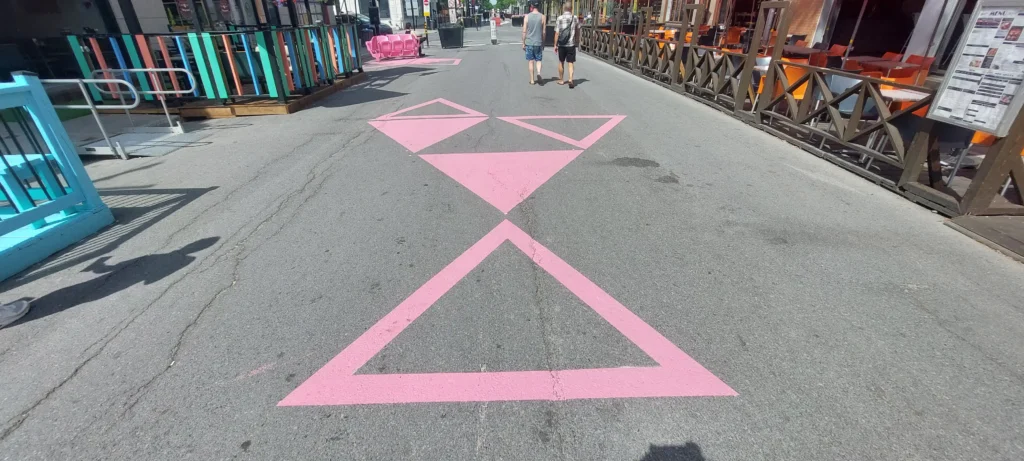
The Gay Village of Montreal now features, among its decorative elements, stylized pink triangles, which has generated numerous negative comments from people who frequent the Village. Some comments even go so far as to accuse one of the LGBTQ+ communities — which we will not name — of being behind this decision.
According to these critics, this segment of our communities would be seeking to seize power at all costs within the Gay Village of Montreal and to erase gay men by imposing, in plain sight, a symbol associated with Nazi persecution.
Gay Globe has not been able to verify these claims, which are at the very least surprising. It remains, however, important to revisit the history of the pink triangle, from its origins to the present day.
The exact origin of the Nazis’ choice of the pink triangle is not fully documented, but it was part of the identification system used in Nazi concentration camps. Nazi authorities assigned a color and a geometric shape to different categories of prisoners in order to identify them quickly.
The triangle was already used as an administrative marker in the camps. Political prisoners wore a red triangle, criminals a green triangle, Jehovah’s Witnesses a purple triangle, individuals considered “asocial” a black triangle, and men accused of homosexuality a pink triangle.
Why the color pink? Historians generally suggest that this color was perceived by the Nazis as associated with femininity and effeminacy. The Nazi regime considered homosexual men to be weak, degenerate, and contrary to its ideal of virile masculinity. Pink was therefore used to stigmatize and publicly humiliate them.
The pink triangle was not a homosexual symbol before Nazism. It was created by the Nazi concentration system as a tool for classification and humiliation of men accused of homosexuality.
However, contrary to certain claims made on social media and in some debates within the LGBTQ+ communities in Montreal, the pink triangle did not remain a Nazi symbol to this day. Its meaning has evolved over time and it has even served the interests of LGBTQ+ communities. This is where critics of the Village’s triangles are mistaken.
After the Second World War, the pink triangle remained for several decades a painful symbol associated with the persecution of homosexual men under the Nazi regime. Gradually, however, activists and organizations defending the rights of homosexual people chose to reclaim this symbol in order to give it a new meaning.
Starting in the 1970s, the pink triangle became a symbol of LGBTQ+ memory, resistance, and pride. The idea was to transform a sign of humiliation imposed by persecutors into an emblem of solidarity and visibility. This approach is part of the broader movement of gay liberation and the fight against homophobia.
During the 1980s, at the height of the AIDS crisis, the pink triangle took on a new dimension. Activist groups such as ACT UP used it in their awareness campaigns to denounce governmental indifference and to remind the public that prejudice against homosexuals had dramatic consequences. In this context, the symbol became a tool for political mobilization and LGBTQ+ rights advocacy.
Over the decades, the pink triangle has also been used in LGBTQ+ memorials, historical exhibitions, and Pride events. For many gay men, it represents both the memory of past suffering and the progress made in LGBTQ+ rights.
There are several examples of the modern use of the pink triangle to empower LGBTQ+ communities. These include the Pink Triangle Committee of the Canadian Union of Public Employees – Quebec, the National Pink Triangle Committee, as well as a Montreal-based association called the Triangles roses.
One of the most well-known examples is the American activist group ACT UP, which was particularly active during the AIDS crisis. It helped popularize the inverted pink triangle accompanied by the slogan “Silence = Death.” This symbol remains a strong marker of LGBTQ+ activist history today.
In the United Kingdom, the Pink Triangle Trust explicitly uses the name of the pink triangle in an educational and activist context, particularly to promote LGBTQ+ rights and historical memory.
The pink triangle can also be found in institutional and commemorative spaces such as the Pink Triangle Park and Memorial in San Francisco, dedicated to homosexual victims of Nazism. There, the symbol is used as a tool of remembrance and historical transmission.
Similarly, several museums and exhibitions dedicated to LGBTQ+ history or Nazi persecution include the pink triangle, including the United States Holocaust Memorial Museum, where it is presented in its historical context of prisoner classification.
There is also an important dimension of LGBTQ+ visibility. In a neighborhood like the Gay Village of Montreal, a stylized pink triangle can serve as a strong urban signal, rooted in the history of LGBTQ+ struggles, while reinforcing the symbolic presence of the community in public space.
Its use can also have educational and artistic value. Integrated into public art or urban design, it opens reflection on the history of discrimination, LGBTQ+ memory, and the reappropriation of symbols.
Where things could have been done better — and it is not too late to do so — would have been to install explanatory panels on the origins of the pink triangle throughout the Gay Village of Montreal, so that the public could better understand its history, its Nazi use, and its later reappropriation by LGBTQ+ communities.
All in all, the pink triangle is not necessarily a bad idea. As seen in our photo above, it can be highly decorative, but better contextualization would have allowed for a more complete understanding of its history, its memorial significance, and its evolution within LGBTQ+ communities.
ADVERTISING

READ ALSO
11,900 Articles Published: Gay Globe Reaches a New Historic Milestone
https://gayglobe.net/en/gay-globe-11900-articles-30-years-lgbtq-media-history/
Gay Globe Magazine – Canadian LGBTQ+ Media Since 1998
https://gayglobe.net/about/
Groupe Gay Globe Media International
https://gayglobe.net/apropos/
Rions un peu : Analyse of Gay Globe by Artificial Intelligence (Gemini, ChatGPT, Grok, Claude)
https://gayglobe.net/analyse-gay-globe-intelligence-artificielle/
The anti-fraud protection of Gay Globe for its readers and users
https://gayglobe.net/the-anti-fraud-protection-of-gay-globe-for-its-readers-and-users/
COVID-19 and mRNA: The Medical Revolution Born from a Pandemic
https://gayglobe.net/en/covid-19-mrna-medical-revolution/
International Aid and LGBTQ+ Rights: The Paradox of Countries Receiving Funding Despite Anti-Homosexuality Laws
https://gayglobe.net/en/international-aid-lgbtq-rights-paradox-anti-homosexuality-laws/
Fibromyalgia and magnesium deficiency: symptoms, diagnosis and supplementation
https://gayglobe.net/en/fibromyalgia-magnesium-deficiency/
Discreet organ, intense sensations: the surprising role of the prostate
https://gayglobe.net/en/prostate-intense-sensations/
When homophobia decides lives
https://gayglobe.net/en/hatred-homophobia-lgbt-testimony-gay-globe/