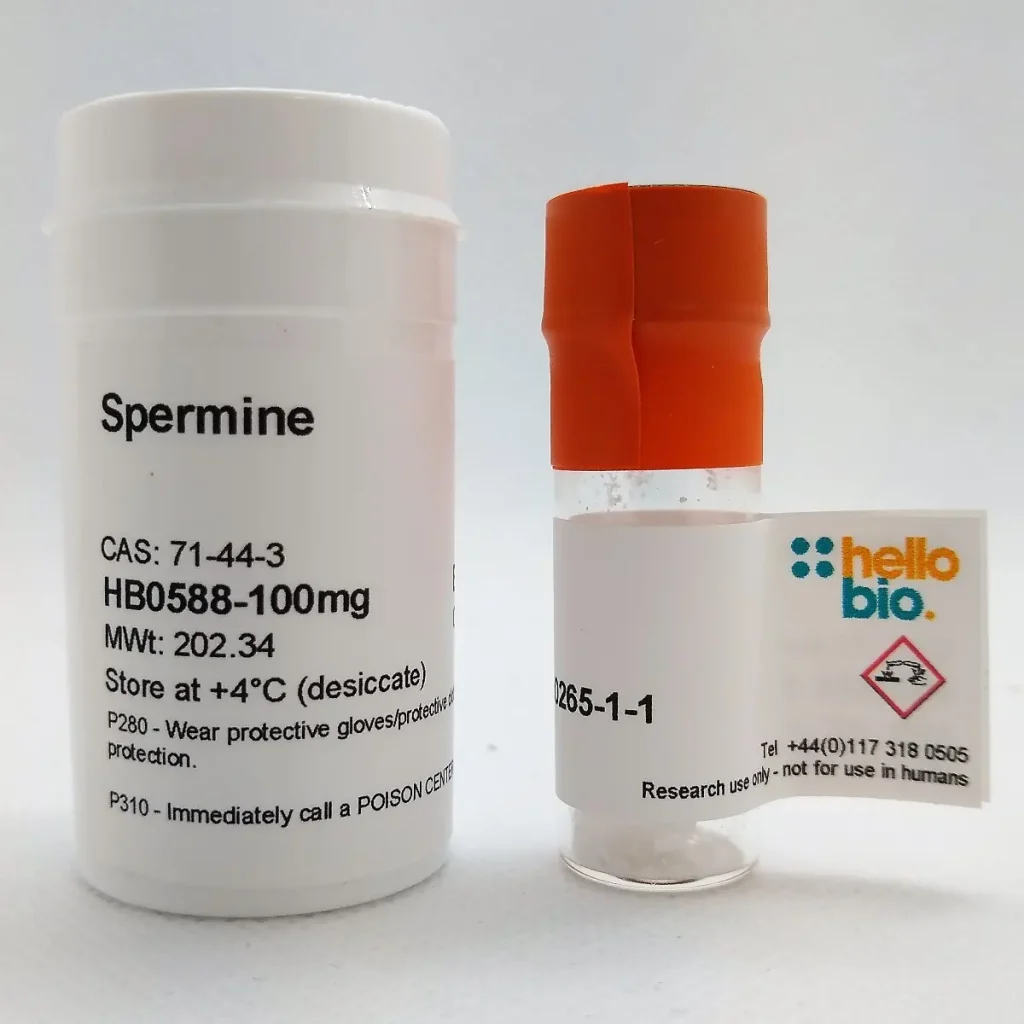
Roger-Luc Chayer (Image : Hello Bio)
Long live medical research
Long live innovative medical research, especially when it leads to the discovery of a simple and easy-to-produce molecule capable of revolutionizing the lives of people affected by neurodegenerative diseases, notably Alzheimer’s disease.
Introducing spermine
Let me introduce spermine, a molecule derived from human semen, known for its extraordinary properties and its specific action on the brain.
What is spermine?
Spermine is a small natural molecule produced by the human body, present in almost all cells, and particularly in semen. It belongs to the family of polyamines, compounds essential for cell growth, DNA protection, and the regulation of numerous biological processes.
For several years, spermine has attracted the attention of researchers for its potential role in brain function, neuronal protection, and the mechanisms of brain aging. Behind a surprising name lies a promising molecule for understanding and possibly treating certain neurodegenerative diseases.
Semen, a medicine?
In the brain, spermine acts as an essential regulator, contributing to the transmission of nerve signals by modulating neuronal receptors. It protects nerve cells against oxidative stress and inflammation, two key factors in brain aging.
How does semen reach the brain?
It is important to clarify that semen does not travel to the brain. The confusion comes from the fact that spermine is a molecule produced locally in many tissues, including the brain, independently of any reproductive function.
The brain produces its own spermine, which circulates between neuronal cells to ensure optimal functioning, without any involvement of semen.
What is the mechanism of action of spermine on the brain?
The mechanism of action of spermine is based on its ability to regulate neuronal activity at synapses, by modulating key receptors, particularly those related to glutamate. It prevents excessive neuronal excitation, which can be toxic.
It also contributes to internal ionic balance within neurons, protects against oxidative stress, and supports neuronal survival as well as brain plasticity, which is essential for the brain’s adaptive capacity.
What is the interest of spermine against neurodegenerative diseases?
Spermine plays a crucial protective role in diseases such as Alzheimer’s, Parkinson’s, and other neurodegenerative disorders. It stabilizes neuronal activity, limits inflammation and oxidative stress, thereby slowing neuronal deterioration.
By supporting brain plasticity and cell survival, spermine helps preserve brain functions in the face of aging and neurological damage.
Can spermine be produced pharmacologically or artificially?
Spermine can be easily synthesized in the laboratory thanks to its simple chemical structure. It is already used in biomedical research.
However, turning this natural molecule into an effective medication requires overcoming several challenges: determining dosage, mode of administration, its ability to cross the blood–brain barrier, and ensuring long-term safety. This is why spermine remains a promising but complex avenue in neurological pharmacology.
A universal molecule
Contrary to common belief, spermine is not produced only by humans. It is present in all living organisms, making it potentially beneficial for all humans.
ADVERTISING