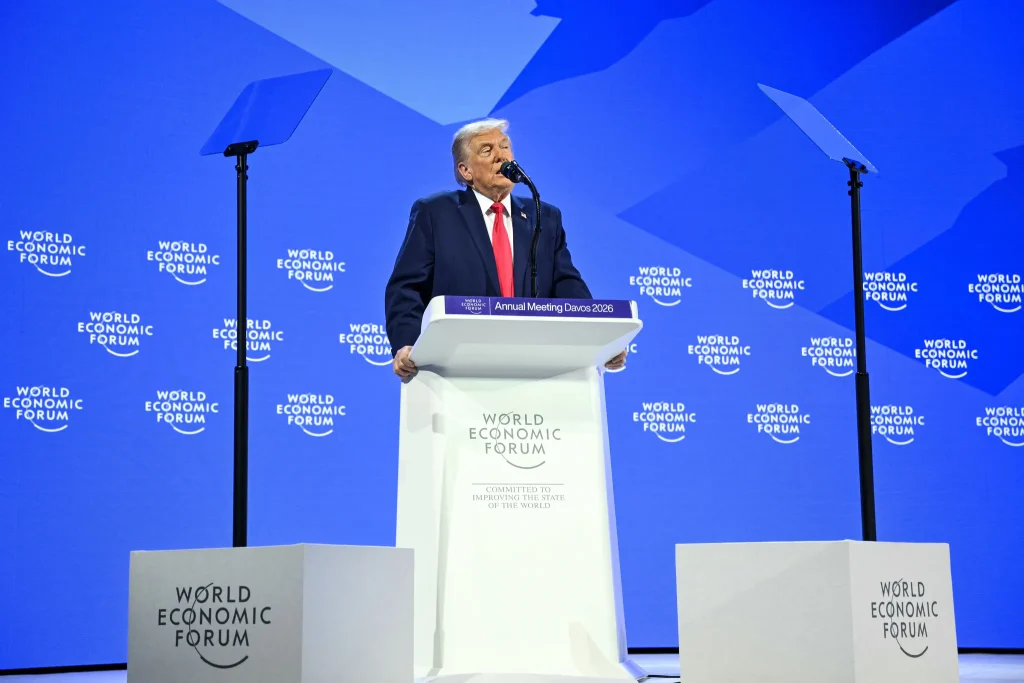
Roger-Luc Chayer (Photo : Trump by AFP)
Donald Trump in Davos: A Monologue Rewriting History
A long session of nonsense just took place in Davos, Switzerland, as the President of the United States, Donald Trump, launched into a monologue rewriting the history of humanity, going as far as declaring that since the Roman Empire, only he has succeeded in changing the face of the world.
He spoke about everything without leaving anything out, covering both internal American affairs and every country in the world, describing some territories as lawless zones without governments, claiming that all the countries on the planet would not exist without the United States, and even confirming that he would not use military force to conquer Greenland—a first official confirmation he repeated several times.
Donald Trump and NATO: A Contested Claim
What shocked observers the most was the statement he repeatedly made, that NATO has never done anything for the United States, while it is the United States that makes NATO exist. An absurd claim that his advisers have probably asked him to stop repeating, but to which he persists. On this point, not only is he lying, and he knows it, but the only time in NATO’s history when Article 5 was invoked was in September 2001, when the United States was attacked.
What is Article 5 of the NATO Charter?
Article 5 of the NATO Charter is the central principle of the Atlantic Alliance. It stipulates that an armed attack against one member state is considered an attack against all members, each committing to assist the attacked country by means it deems necessary, including, if necessary, the use of armed force. This article embodies the concept of collective defense and forms the very foundation of NATO’s existence and credibility.
The Only Invocation of Article 5 in NATO History
The only moment in NATO’s history when Article 5 was invoked was in September 2001, following the September 11 attacks carried out against the United States. For the first and only time since the Alliance’s creation in 1949, the allies recognized that an attack against one member state constituted an attack against the whole NATO, thus triggering the principle of collective defense set out in the Charter.
Concrete NATO Actions to Defend the United States
Following the invocation of Article 5 in September 2001, NATO members took a series of concrete measures to support and defend the United States, marking the first real implementation of the principle of collective defense. In the days following the attacks, allies strengthened North American air security by deploying surveillance and combat aircraft over American territory as part of Operation Eagle Assist, thereby relieving the US Air Force and ensuring the protection of US airspace.
At the same time, naval assets were deployed in the Mediterranean to prevent any further terrorist threats, with patrols securing maritime routes and monitoring suspicious movements. Allies also massively shared intelligence, intensifying cooperation in counterterrorism and internal security, which played a key role in identifying and dismantling networks linked to Al-Qaeda.
Militarily, this solidarity translated into direct support for US operations in Afghanistan. Many NATO member countries participated in the intervention and, subsequently, in the NATO-led International Security Assistance Force, providing troops, equipment, logistics, and operational support over many years. These commitments represented a significant human, financial, and political cost for several allies.
NATO, the United States, and Historical Reality
All these actions demonstrate that, contrary to some claims, NATO did not merely express symbolic support for the United States but acted militarily, operationally, and strategically for their defense, in accordance with the obligations set by Article 5 of its Charter.
When Donald Trump repeatedly claims that NATO has never done anything for the United States, he humiliates the United States itself, which has been the sole beneficiary of Article 5 in the organization’s history.
NATO and LGBT Rights: An Institutional Evolution
According to NATO’s website and available documentation, NATO’s contributions to LGBT rights do not take the form of direct political activism but are part of a profound institutional evolution aiming for equality, non-discrimination, and the protection of human rights within the armed forces and security structures. Since the 2000s, the Alliance has gradually integrated the principle that sexual orientation and gender identity cannot justify exclusion, discrimination, or harassment within the armies of member countries, considering that such practices harm cohesion, operational efficiency, and the democratic values NATO claims to uphold.
Internally, NATO has implemented explicit diversity and inclusion policies applicable to its civilian and military personnel, prohibiting any discrimination based on sexual orientation or gender identity. Mandatory training on respect, equality, and harassment prevention has become widespread in command structures, and leaders are required to guarantee a safe working environment for LGBT individuals.
The Alliance also recognizes same-sex partners for international assignments, social benefits, and administrative protections, which marked an important advance in a historically conservative military context.
At the operational and strategic level, NATO has integrated human rights, including those of LGBT people, into its normative frameworks, notably through implementing the Women, Peace and Security agenda and the so-called human security approach. On missions abroad, the Alliance encourages its forces to respect and promote fundamental rights, prevent sexual violence, and understand vulnerability dynamics affecting minorities, including LGBT people, in conflict zones. Although NATO does not impose social policies on partner states, it insists on minimal respect for human rights as a condition for sustainable cooperation.
ADVERTISING