English below
Roger-Luc Chayer (Image : IA / Gay Globe)
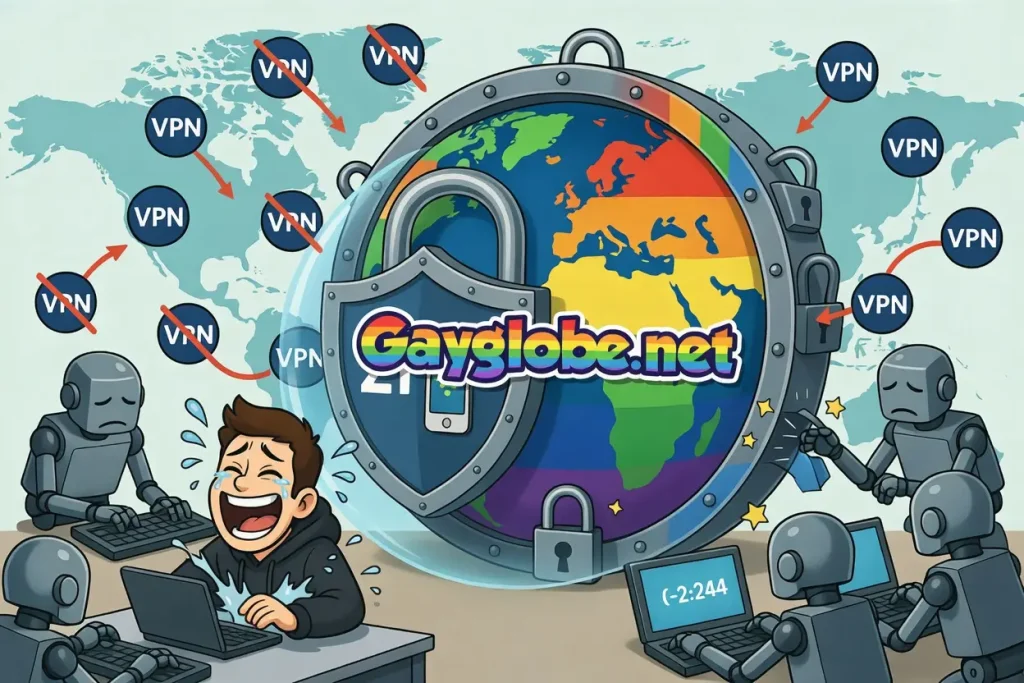
Hasard ou pas, le site web de Gay Globe Média au Gayglobe.net a fait l’objet ce matin d’une attaque informatique rarement vue alors qu’un individu ou un groupe, pendant une trentaine de minutes, plus précisemment, une attaque par force brute sur l’authentification.
Comprendre l’attaque
Une attaque par force brute sur l’authentification peut être décrite comme une tentative d’intrusion informatique automatisée durant laquelle un pirate ou un programme malveillant essaie de se connecter à un site, un compte ou un service en testant massivement des combinaisons d’identifiants et de mots de passe jusqu’à en trouver une qui fonctionne.
Mode opératoire des attaquants
Autrement dit, plutôt que de “deviner” de manière intelligente, l’attaquant procède par répétition systématique, souvent à l’aide de robots, en essayant un très grand nombre de noms d’utilisateur et de mots de passe en un temps très court. Ce type d’attaque vise les formulaires de connexion classiques, comme ceux des sites web ou des plateformes d’administration, et exploite principalement des mots de passe faibles ou réutilisés.
Dispositif de protection en place
Sans vous livrer nos secrets de protection, Gay Globe a mis en place, il y a quelques années, plusieurs couches de sécurité qui rendent très difficile le succès de ce type d’attaques. Il faut évidemment saisir le bon mot de passe, puis passer par une authentification à deux facteurs, dont la seconde étape consiste en la création d’un code numérique aléatoire, valide seulement pendant une minute. Et, surprise, une troisième étape, invisible à l’œil, complète ce dispositif, sans que nous puissions en détailler ici le fonctionnement.
Origine de l’attaque et résultats
Cette attaque a été menée en utilisant un VPN (Virtual Private Network), permettant de lancer plusieurs tentatives d’intrusion depuis différents pays simultanément. Toutes ces tentatives se sont soldées par un échec, et l’adresse IP de chaque réseau utilisé à été bloquée pour une durée de deux mois.
PUBLICITÉ / ADVERTISING

Coincidence or not, the Gay Globe Média website at Gayglobe.net was the target this morning of a rarely seen cyberattack while an individual or a group, for about thirty minutes, more precisely, a brute force authentication attack.
Understanding the attack
A brute force authentication attack can be described as an automated attempt at computer intrusion in which a hacker or malicious program tries to log into a website, account, or service by massively testing combinations of usernames and passwords until one works.
Attack method
In other words, rather than “guessing” intelligently, the attacker proceeds through systematic repetition, often using bots, trying a very large number of usernames and passwords in a very short time. This type of attack targets standard login forms, such as those of websites or administration platforms, and mainly exploits weak or reused passwords.
Security system in place
Without revealing our security secrets, Gay Globe has implemented several layers of protection over the years that make the success of such attacks very difficult. A correct password must of course be entered, followed by two-factor authentication, the second step consisting of the creation of a random numerical code valid for only one minute. And, surprisingly, a third invisible layer completes this system, which we cannot detail here.
Origin and outcome of the attack
This attack was carried out using a VPN (Virtual Private Network), allowing multiple intrusion attempts from different countries simultaneously. All these attempts failed, and each IP address used was blocked for a period of two months.
PUBLICITÉ / ADVERTISING