Roger-Luc Chayer (Photo : (Before) Google Street View (after) Groupe Gay Globe Média)
Catastrophic Traffic Management in Montreal under Valérie Plante
All residents of the greater Montreal urban area know that Mayor Valérie Plante has done everything possible to stifle motorized traffic, driven by a desire to satisfy her ego and assert her dominance over the City of Montreal. Orange cones, continuous changes in traffic directions, blockages caused by hundreds of ghost construction sites where absolutely nothing happens, as well as street closures under the pretext of “greening” the city, all contribute to a massive destruction of Montreal’s traffic grid at every level.
Mayor Plante and her collaborators seem to forget that, unlike very dense European cities — Paris intra-muros, for example, measures only about nine kilometers from north to south — the island of Montreal covers 499 square kilometers and was designed not for proximity, but for industrialization and urban mobility. Montreal is above all a city of transport and traffic.
Montreal is Not Paris or Rome, Madame Plante
Montreal was conceived in a context where industrialization dictated the way cities were planned. Its location on the Saint Lawrence River made it a strategic point for commerce, favoring the construction of a port, railways, and later roads intended to transport goods rather than structure a residential city. Working-class neighborhoods developed around industrial zones, and the road network followed this logic of transport and production.
Unlike Paris, whose layout was fixed long before the industrial era, Montreal grew at a time when the mobility of goods and the proximity of factories mattered more than beauty or urban friendliness. This explains the presence of large, straight, functional arteries designed to quickly connect the port, factories, and industrial suburbs of Montreal.
Dogmatism That is Killing the City of Montreal
The dogmatism of Mayor Valérie Plante is destroying what had functioned so well until her rise to power.
By paralyzing all the main arteries of the city, she is blocking the heart of Quebec and Canada, just as a blood clot can block an artery and cause a heart attack. We all know that a heart attack can cause permanent damage, or even death. This is exactly what is happening in Montreal.
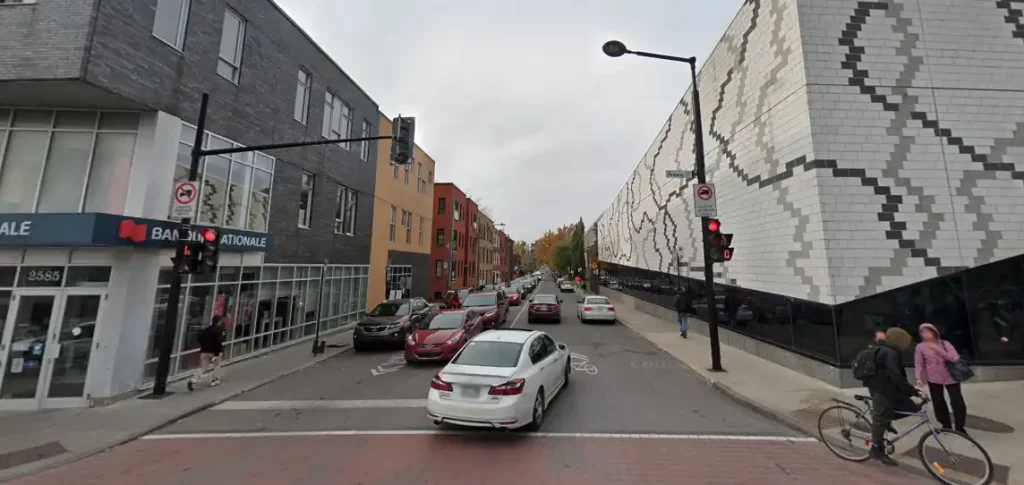
Rue du Havre Between Ontario and Hochelaga Before the Changes
Rue du Havre is a striking example
The photo above shows Rue du Havre, in the Ville-Marie borough, directly under the responsibility of Mayor Valérie Plante. It shows a vibrant and functional street, with four north-south lanes, parking on both sides, and heavy traffic. Two lanes allowed smooth vehicle flow while maintaining good accessibility. Priority bike lanes had even been installed on both sides, ensuring safety and smooth bicycle traffic. So why fix what wasn’t broken?
Through incompetence, dogmatism, or sheer irresponsibility? The question must be asked, because, as usual with the thousands of kilometers of traffic lanes in Montreal, Valérie Plante consults no one: she imposes, dictates, and commands.
Catastrophic Redevelopment of Rue du Havre
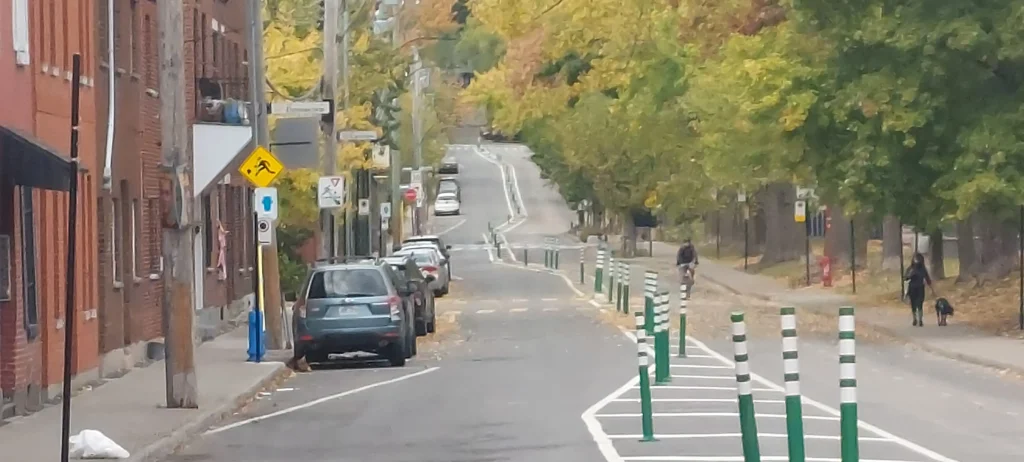
The mayor therefore ordered that Rue du Havre, between Ontario and Hochelaga streets — already the site of a veritable festival of permanent concrete blockages — be completely redeveloped and obstructed by all possible means. In the photo above, the catastrophic results of this decision are evident at every level.
Only three lanes remain: an entirely non-standard bike lane, wider than average and marked with useless zigzags that hinder flow, and a single car lane from south to north with incoherent arrangements, breaks, scattered concrete blocks, and a logic that is difficult to understand.
Worse still, 95% of the parking spaces on the street for residents and motorists have been removed, to the great despair of the public. And as if that weren’t enough, the few remaining spots have been crosshatched, reducing their number from about 150 to barely ten.
An Intersection That Could Kill
A worrying new feature in the Rue du Havre redevelopment concerns the intersection with Rue de Rouen. Stop signs have been installed at all four corners, but cyclists, seeing a crosswalk across Rue du Havre, never stop and cross at full speed.
Vehicles traveling south to north on Rue du Havre do stop at the corner of Rouen, but visibility is heavily limited by a residential building at the intersection, preventing drivers from seeing what is coming from Rouen. The result: cyclists, who do not stop — I observed the situation over several days and 100% of them ignore the stop — are exposed to a serious, potentially fatal accident.
At the speed they travel, if a vehicle stops and then restarts assuming that cyclists will obey the stop sign, a collision would be inevitable otherwise. Obviously, no one enforces the law, neither police nor wardens, and violations occur every minute, especially during rush hour.
Conclusion: Montreal Sacrificed under Valérie Plante
The redevelopment of Rue du Havre alone illustrates a blind and dangerous municipal management: under the pretext of modernizing and “greening” the city, safety, flow, and common sense are sacrificed, turning a functional artery into a daily trap for motorists and cyclists. If this is Montreal’s vision, the city is heading straight for chaos rather than progress.
ADVERTISING