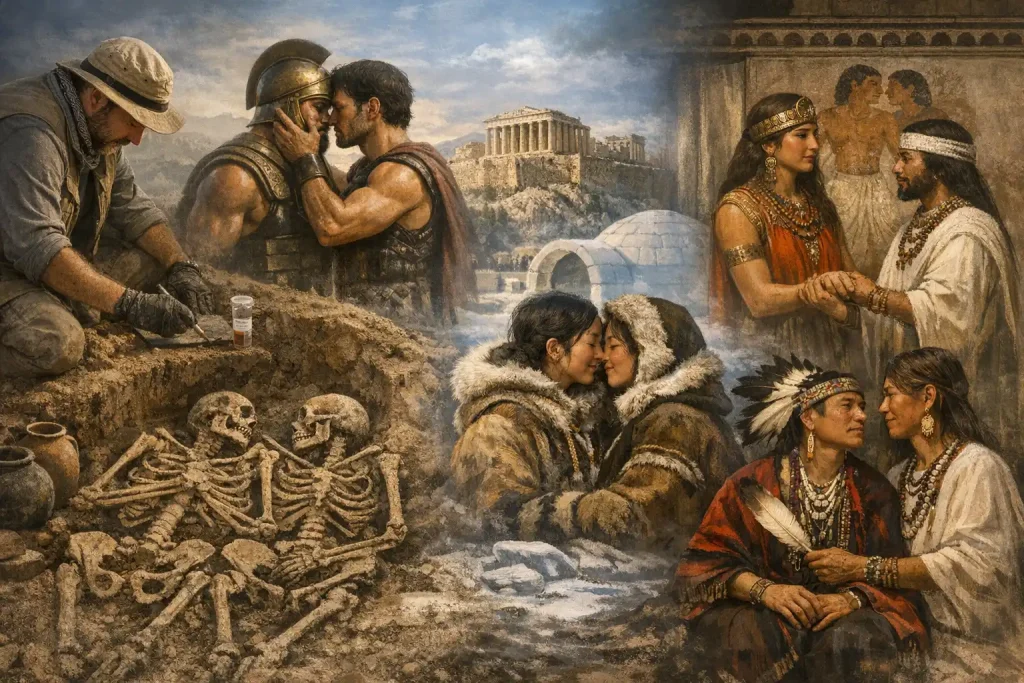
Roger-Luc Chayer et Arnaud Pontin (Image : AI / Gay Globe)
We are often asked whether homosexuality existed in prehistory and in archaeology. The question is a compelling one, since we all know that sexual orientation has always been part of humanity and has expressed itself in different ways across cultures. Encouraged for military and cultural purposes among the ancient Greeks, accepted among the Romans as a demonstration of virility, acknowledged among Inuit peoples, who did not believe in a strict division of the sexes, in short, as far back as our knowledge reaches—or almost—homosexuality has been present.
Homosexuality in Antiquity: Between Social Practices and Modern Anachronisms
The short answer is this: these claims are not entirely false, but they are simplified and deserve nuance in order to be historically accurate.
Among the ancient Greeks, relationships between men were indeed socially integrated in certain city-states and at specific periods, notably in the form of institutionalized pederasty between an adult man and an adolescent. These bonds were sometimes associated with military contexts, such as in Thebes with the Sacred Band, composed of male couples. However, this did not amount to a “generalized encouragement” of homosexuality in the modern sense of the term. The Greeks did not think in terms of sexual orientation, but rather in terms of social roles (active/passive, citizen/slave, adult/youth).
Among the Romans, the situation was also more complex than the idea of simple acceptance as a demonstration of virility. What mattered above all was social status and the role played in the act. A free Roman citizen could have relations with men, provided he occupied the dominant role and that his partner was of lower status (slave, freedman, prostitute). Being perceived as passive, on the other hand, was heavily stigmatized. Again, one did not speak of “homosexuality” as an identity.
Inuit Peoples and Gender Diversity: Between Anthropological Reality and Simplification
Certain Inuit societies did recognize flexible gender roles, notably through practices of reverse socialization (children raised as belonging to the other sex) or shamanic figures who could cross gender boundaries. However, this does not mean the total absence of gender distinctions nor a universal acceptance of same-sex relationships. Realities varied according to region and historical period.
Queer Archaeology: What Evidence of Queer Identities in Precolonial and Premodern Societies?
But what about queer archaeology, and the evidence of queer identities in precolonial and premodern societies around the world?
Queer archaeology does not merely seek “proof of homosexuality” in the past. It challenges the way archaeologists have long interpreted material remains through a heterosexual and binary lens. For decades, when two individuals were found buried together, they were automatically described as “brother and sister” or “husband and wife.” Queer archaeology invites us to ask: what if that was not always the case?
That said, caution is essential. Archaeology almost never allows us to identify a sexual orientation in the modern sense. We may observe unusual burial practices, individuals interred with objects associated with another gender, or artistic representations depicting relationships between people of the same sex, but this does not constitute “proof” of homosexual identity as defined today.
There are, however, several intriguing types of evidence in precolonial and premodern societies.
In some tombs, DNA analyses have revealed that individuals buried together and interpreted as heterosexual couples were in fact of the same biological sex. This opens up hypotheses, without allowing definitive conclusions about the nature of their relationship.
In various Indigenous cultures of the Americas, long before European colonization, non-binary gender roles were socially recognized. What is today grouped under the term Two-Spirit corresponds to specific and ancient cultural realities, documented in early ethnographic and colonial sources. Here, we have strong historical evidence of multiple gender identities, even if contemporary vocabulary should not be projected directly onto the past.
In South Asia, Mesopotamia, ancient Egypt, Africa, and Oceania, texts, artistic representations, and oral traditions also suggest the existence of same-sex relationships or fluid gender figures. Yet archaeology alone is rarely sufficient; it must be cross-referenced with written sources and anthropology.
Sexual and Gender Diversity in History: A Documented Reality
The central point is this: there is abundant evidence that precolonial and premodern societies recognized diverse sexual practices and, in some cases, social categories that did not correspond to the modern Western binary model. However, speaking of “queer identities” in the contemporary sense remains delicate. The risk is anachronism—that is, projecting our current categories onto societies that understood sex, gender, and desire differently.
Queer archaeology therefore does not aim to prove that “gay people have always existed” in the modern identity-based sense, but rather to demonstrate that sexual and gender diversity is historically documented and that the past is far more complex than the long-dominant narrative once suggested.
ADVERTISING