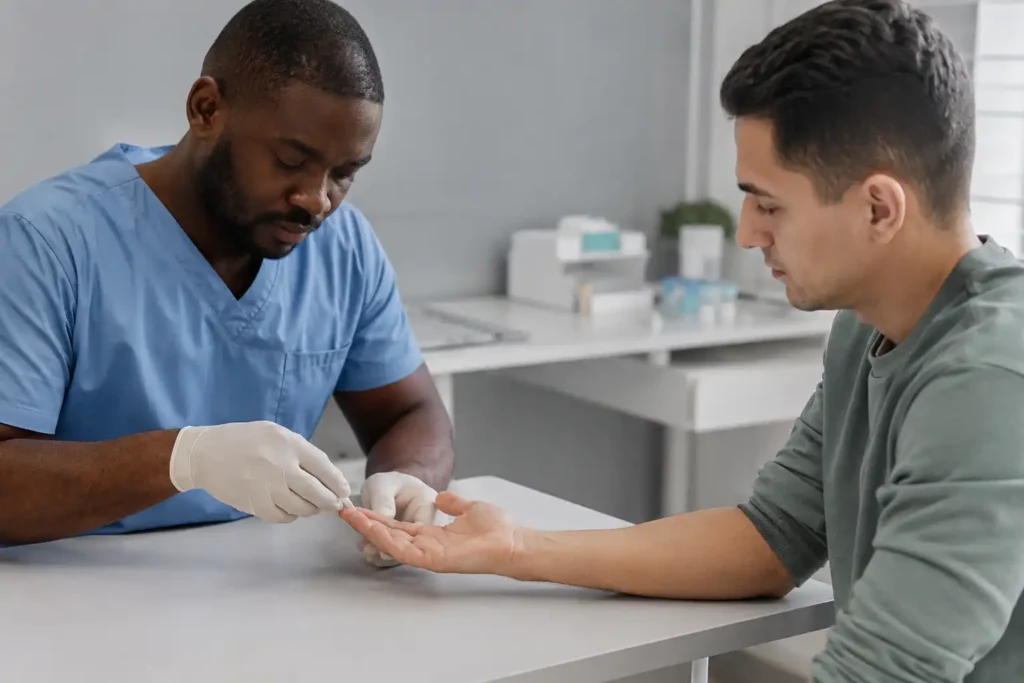
Carle Jasmin (Image : AI / Gay Globe)
New statistics from North America and Europe reveal alarming figures regarding the spread of HIV, particularly the growing number of AIDS cases in our countries. The good news is that infection rates remain stable among the local population. However, the situation is different among migrants who arrive as temporary foreign workers or refugees. Within this population, the HIV rate is higher, contributing to an increase in national averages.
In most countries across North America and Western Europe, the number of new HIV infections among people born in the country or long-term residents has generally declined or remained relatively stable for several years, thanks to HIV testing, antiretroviral therapy, and the widespread use of PrEP.
However, surveillance data show that in several countries, a growing proportion of new HIV diagnoses involves people born abroad, particularly those originating from regions where HIV prevalence is higher. This reality contributes to maintaining, and in some cases increasing, the total number of diagnoses, even as local HIV transmission declines.
Part of the explanation is that some of these migrants were already HIV-positive before arriving, while others acquire the virus because of difficult social conditions, fear of stigma, reluctance to undergo HIV testing, or limited access to healthcare services. The situation also varies depending on the country of origin and cultural context.
There is no need, in this article, to identify the countries most affected, as doing so would only reinforce stigma, which is not the purpose of this text.
New HIV cases among migrants, as with any other population, have economic consequences and place additional demands on healthcare systems. However, these impacts should be presented with nuance, as they result primarily from healthcare needs and barriers to accessing services rather than from migration status itself.
From an economic perspective, HIV treatment represents a long-term investment. People living with HIV require regular medical follow-up, antiretroviral treatment, laboratory testing, and sometimes care for complications or other illnesses. These costs are generally covered, in whole or in part, by public healthcare systems in many Western countries.
When an HIV diagnosis is made late, healthcare costs increase significantly. A person diagnosed at an advanced stage may require hospitalization, intensive care, and more complex treatments than someone whose HIV infection was detected early. Early HIV testing is therefore not only beneficial for individual health but also more cost-effective for public healthcare spending.
Within healthcare systems, an increase in the number of people living with HIV raises demand for HIV testing services, specialized clinics, laboratories, physicians, nurses, and prevention programs. If the increase is substantial, it can place additional pressure on already limited healthcare resources.
More broadly, when a person is not treated promptly, they are more likely to transmit the virus. Conversely, someone receiving effective treatment whose viral load becomes undetectable does not transmit HIV through sexual contact, according to the scientific principle U = U (Undetectable = Untransmittable). Investing in HIV testing and access to treatment therefore helps reduce both future healthcare costs and new HIV infections.
It should not be concluded that migrants represent an economic burden. Many migrants work, pay taxes, and contribute directly to financing public services. The costs associated with HIV should be viewed from a public health perspective: the sooner people—whether born in the country or elsewhere—have access to HIV testing and treatment, the greater the benefits for both their health and public finances.
What Are the Benefits of Early HIV Testing?
Early HIV testing offers significant benefits for individuals, public health, and healthcare systems.
For individuals, it allows antiretroviral treatment to begin as soon as possible. Today, these therapies are highly effective, enabling most people living with HIV to enjoy long, healthy lives with a life expectancy close to that of the general population when the diagnosis is made early.
Early HIV testing also reduces the risk of developing AIDS and opportunistic infections. The sooner treatment begins, the better it protects the immune system, reducing the risks of hospitalization, severe complications, and death.
From a prevention standpoint, a person receiving effective treatment can achieve an undetectable viral load. According to the scientific principle U = U (Undetectable = Untransmittable), they no longer transmit HIV through sexual contact. HIV testing is therefore an essential tool for reducing new HIV infections.
For healthcare systems, an early diagnosis is also less expensive. It helps prevent hospitalizations, complex treatments, and intensive care associated with advanced disease. Resources can therefore be directed toward prevention and outpatient care rather than the management of serious complications.
Early HIV testing also facilitates the support of sexual partners and people who may have been exposed to the virus, allowing them to be tested and, if necessary, receive prompt treatment or PrEP (pre-exposure prophylaxis). This approach helps reduce HIV transmission throughout the population.
Immigrants should not be blamed for the increase in HIV cases. Instead, it is essential to better inform newcomers, improve access to early HIV testing, and ensure they receive the treatment to which everyone is entitled. Such an approach protects individual health, reduces HIV transmission, and strengthens the effectiveness of healthcare systems.
ADVERTISING

READ ALSO
https://gayglobe.net/en/gay-globe-11900-articles-30-years-lgbtq-media-history/ — 11,900 Articles Published: Gay Globe Reaches a New Historic Milestone
https://gayglobe.net/category/spot/page/151/ — Election Day at Chick-fil-A
https://gayglobe.net/category/spot/page/151/ — Black Gay People Face Serious Problems Accessing Public Services
https://gayglobe.net/category/spot/page/151/ — Can mass HIV testing really end AIDS?
https://gayglobe.net/category/spot/page/124/ — Forms of HIV can cross from chimps to humans, study confirms
https://gayglobe.net/category/spot/page/124/ — Male Escorts Are Making a Killing Off Closeted Gay Republicans at the RNC
https://gayglobe.net/category/spot/page/124/ — Eating disorder behaviour on the rise for gay, lesbian, bisexual youth: UBC study
https://gayglobe.net/category/spot/page/124/ — How Donald Trump Courted Gay Voters at the Convention
https://gayglobe.net/category/spot/page/124/ — John Cho Says Gay Kiss Was Cut In Star Trek Beyond
https://gayglobe.net/category/spot/page/6/ — Anthony Perkins, the Tormented Actor: Homosexuality, Electroshock Therapy, and AIDS