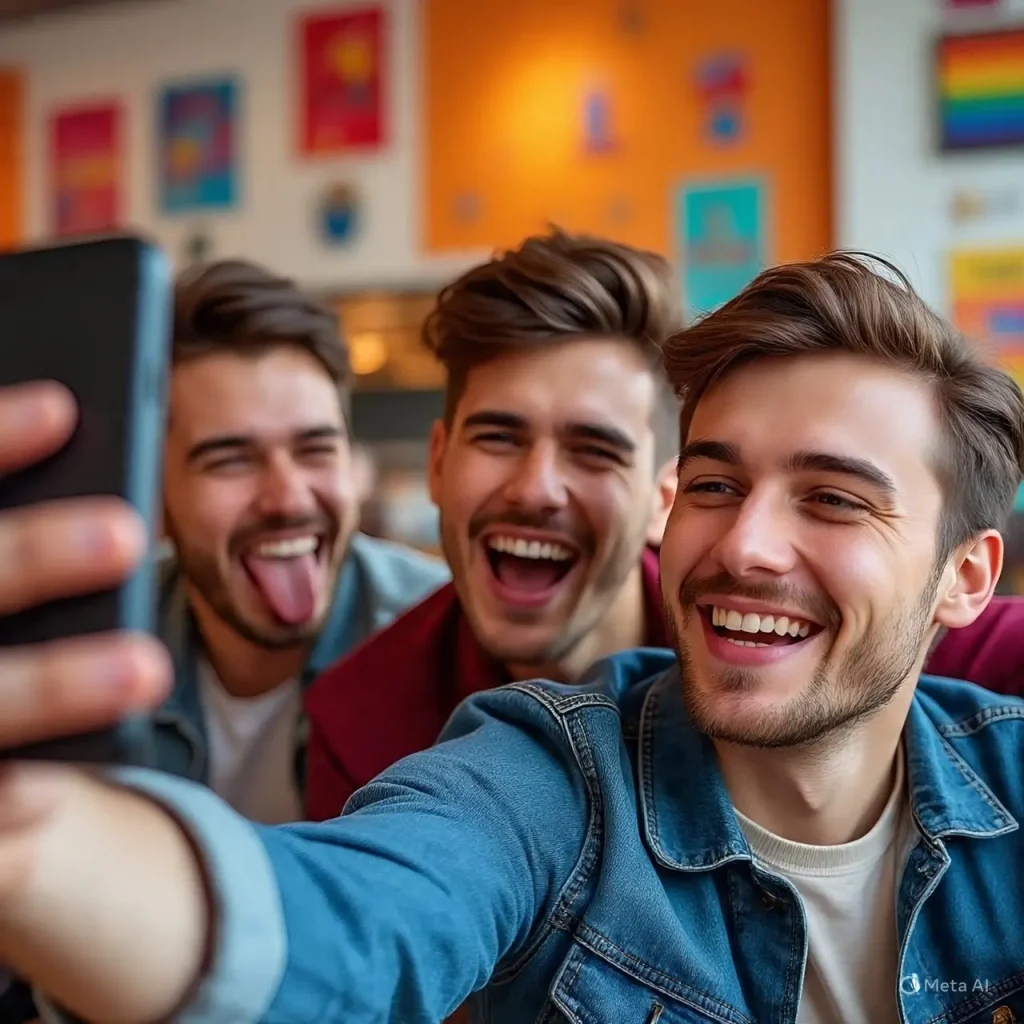
Roger-Luc Chayer (Image : Meta AI / Gay Globe)
The social landscape is changing across all spheres of society, and this has become even more evident since the democratization of social media, now accessible through numerous platforms, especially smartphones.
In the general population and in places like bars, festivals, or public events, people under 30 remain very present and often have a specific budget dedicated to leisure activities.
However, this does not seem to be the case within the gay community. What explains this apparent absence of young gay men in the urban landscape?
Several academic studies and sociological surveys suggest that the apparent “disappearance” of gay men under 30 from traditional LGBT venues is due to a combination of generational, technological, social, and cultural factors.
First, the growing acceptance of homosexuality in mainstream society leads LGBTQ youth to socialize in mixed contexts rather than exclusively LGBT spaces. According to the Wikipedia article on gay neighborhoods, the new generation feels less need to claim a space dedicated to displaying their sexual orientation, as tolerance has spread widely throughout the population.
This phenomenon corresponds to observations on Reddit, where members of the queer community report that traditional LGBT villages are based on a model of homosocialization that is less attractive to youth, less “cool,” and neglectful of inter-orientation dynamics.
The intensive use of dating apps (Grindr, Tinder, etc.) and social networks has transformed interaction patterns: these digital spaces partly replace physical venues, especially among a more “connected” generation where meetings happen online.
Moreover, in existing physical LGBT spaces—bars, associations, community centers—there is a predominance of patrons aged 30 to 40 and older. A Canadian user recounted in Le Monde that at 24, he was often the youngest person in a local queer center, which made him feel like he didn’t truly belong.
In small towns and rural areas, the social life of gay adults still largely revolves around local associations or the neighborhood bar—often the only places to gather. The problem is, these places are mostly frequented by older people and do not necessarily reflect the full diversity of today’s queer community.
As a result, young people—especially those who identify outside the traditional gay model—often prefer to stay online or attend occasional events rather than settle into a venue where they don’t really see themselves.
In Canada, several studies show that gay men aged 65 and over still face isolation, memories of discrimination, and sometimes health issues. But some also have a certain financial stability that allows them to continue frequenting community spaces regularly. This more constant presence of older members naturally raises the average age in these environments.
But this lesser presence is not inevitable.
The Gay Village of Montreal is a good example of a comeback driven by entrepreneurs and business owners who have implemented concepts and offers designed for everyone, including young people—and it’s working!
Compared to gay neighborhoods in other major North American or European cities, the trend of an aging clientele is widespread. But in Montreal, thanks to significant investments from new business owners—often gay themselves and well acquainted with the local scene—the Village is making a comeback. Young people are gradually coming out of their shells to participate in a variety of lively themed parties, reminiscent of the good old days when Montreal’s Gay Village was the true mecca of festive nights.
Organizations like Fierté Montréal also play a key role in attracting a new generation to the Village and restoring precious visibility to a gay culture that many young people today know little about. They don’t know what they’re missing… Because for those who experienced it in the 1990s, the Village was, for all of southern Quebec, the place to be seen.
Social media are not a guarantee of safety!
And what about the social networks and dating apps that young gay men use to build their social circles, often focused on love or sex, but where gay history and culture are rarely promoted? Unfortunately, platforms like Grindr or Gay411 have recently been exploited by homophobic groups who use them to trap young gay men, assault, beat, and humiliate them. These attacks leave deep, sometimes lifelong scars.
Faced with this violence, these apps are beginning to lose popularity in favor of gay establishments, perceived as safer due to the reassuring presence of a large and diverse clientele.
Private meetings, whether at home or in parks, may also lose appeal if the revival of Montreal’s Gay Village continues. Supported by a resilient and inventive business community, the neighborhood offers a vibrant, human, and above all safer alternative for young people who want to gather, socialize, and have fun without having to hide.
ADVERTISING
