Roger-Luc Chayer (Image : AI / Gay Globe)
Everyone in Quebec knows: Montrealers have chosen a new administration with the team of Soraya Ferrada Martinez and Claude Pinard, who announced the City’s priorities on several issues immediately after their election.
The main announced priorities
The housing crisis
One of the central commitments concerned the construction and access to affordable and social housing to address the shortage affecting Montreal. The new administration also promised to accelerate real estate projects and reduce bureaucratic delays related to permits.
Homelessness and the street crisis
The team made the fight against homelessness a priority, promising to better coordinate interventions on the ground and manage encampments in public spaces. A tactical intervention group was to be established to coordinate municipal and community services.
Cleanliness and quality of life in neighborhoods
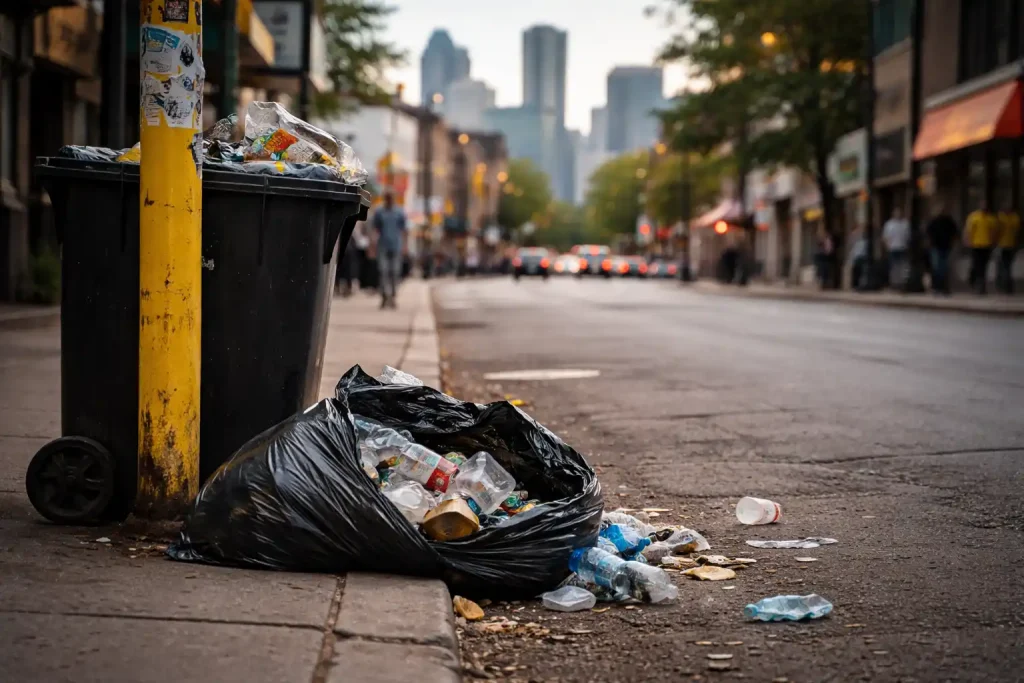
Another goal was to restore cleanliness in streets and public spaces, an issue often raised by citizens during the campaign. This includes waste management, urban maintenance, and improving the appearance of neighborhoods.
Safety and sense of security
The new administration also emphasized the need to strengthen the sense of security in the city, particularly in areas affected by crime or social issues linked to homelessness.
Mobility and construction management
Another important focus was urban mobility, with a promise to better coordinate the many construction projects and improve traffic flow. The goal was to reduce congestion and make travel smoother.
A more efficient municipal administration
Finally, the mayor’s team promised a more rigorous management of the city, including streamlining bureaucracy and improving the efficiency of municipal services.
Contrast with the previous administration
This is no small task, and these announcements represent a major challenge, contrasting with the previous administration of Valérie Plante and Robert Beaudry, which left the metropolis in a lamentable state at all levels.
In my opinion, the greatest challenge, beyond homelessness and the housing crisis, since it involves human lives, is cleanliness. For example, the Ville-Marie borough, which includes Montreal’s Gay Village, contains all the elements likely to make the city dirty, and the causes stem from decisions by both the Montreal city government and the Quebec government.
The two main factors of chaos and uncleanliness in Ville-Marie
The decision by municipal authorities to concentrate all community and social services for homeless people, drug users, those involved in prostitution, or suffering from mental illness in a single quadrant has obvious consequences. This concentration naturally attracts a disproportionate number of clients and beneficiaries compared to other boroughs on the island of Montreal. Don’t tell me Westmount faces the same problem: different city, different administration, just a few streets away from Ville-Marie.
Concentrating all these services in one area creates several interconnected problems: it attracts a large number of vulnerable people, causes potentially conflicting or dangerous interactions, puts enormous pressure on public spaces and infrastructure, and can create a stigma for the neighborhood.
Deposits: an aggravating factor
Another major problem for the borough is assigning value to waste. Let me explain:
When the Quebec government decided to implement a deposit system on plastic bottles, cans, wine bottles, etc., it assigned a monetary value to these containers. The goal is to encourage recycling and reduce waste in nature while creating an economic incentive to recover containers.
However, in densely populated and vulnerable areas like Ville-Marie, this value attracts a large number of people seeking to collect containers, leading to disorder, uncleanliness, and tensions with residents.
The visible impact in the Village
Anyone walking through the Village the day before trash collection sees week after week hordes of people rummaging through each garbage bag to collect even the smallest depositable item, leaving the rest scattered on the sidewalk. Residential bins are sometimes dumped onto the street, and leftover waste is never returned to the bins.
The result: the neighborhood ends up in a state of uncleanliness that did not exist before the deposit system was introduced. Montreal, once known for its exemplary cleanliness, is seeing its image deteriorate in certain areas.
Possible solutions
The challenge for Montreal is clear: to balance the high presence of people in need with the deposit system. In several European countries, the deposit system does not exist: secure recycling bins are placed in strategic locations, and only the city can empty them at regular intervals.
To give the Village a chance to recover, the city could distribute services in clusters across the territory. Supervised injection sites could be placed in industrial areas with free transportation for beneficiaries, and services for homeless people could be offered in less densely populated boroughs.
Moreover, the Greater Montreal region could benefit from an exemption from the deposit law, removing any monetary value from containers, which would strongly limit the phenomenon of “treasure hunters” in the trash. The city could then implement a cleaner and easier-to-manage recycling system, avoiding the need for cleanup crews who only collect remnants without providing a long-term solution.
Your opinion matters
The effect would be immediate, I am certain. What do you think? Please comment at the bottom of this article and feel free to propose your own solutions.
ADVERTISING

READ ALSO:
Gay, lesbian, and transgender youth overrepresented in homelessness — This article explores how homelessness disproportionately affects LGBTQ2S+ youth in major cities including Montreal, and discusses how the Village, historically a safe space, has become one of the visible faces of that crisis.
https://gayglobe.net/gay-lesbian-and-transgender-youth-overrepresented-in-homelessness/
The Ville‑Marie borough in Montreal is the only one experiencing a decline in property values — This piece analyzes the decline in property values in Ville‑Marie (including the Gay Village) and links it to local issues such as vacant buildings, social challenges, and the neighborhood’s image.
https://gayglobe.net/the-ville-marie-borough-in-montreal-is-the-only-one-experiencing-a-decline-in-property-values/
Place du Village: Welcome to the new “Villagestan” — An investigative article depicting the situation around Place du Village in Montreal, describing concerns from residents about crime, social disorder, and safety in a central area of the Village.
https://gayglobe.net/place-du-village-welcome-to-the-new-villagestan/