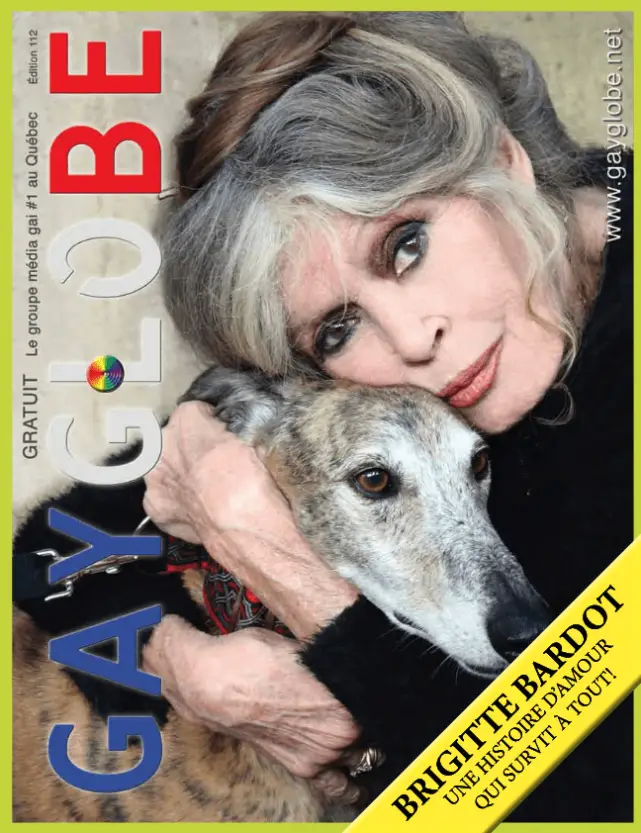
Roger-Luc Chayer (Image: Cover of Gay Globe Magazine #112)
Death of Brigitte Bardot: A Global Icon Passes Away
Brigitte left us yesterday at the age of 91, a venerable age for a remarkable lady. Madame Brigitte Bardot changed France, or rather, the world, through her art and convictions. She was the most beautiful woman in the world, the most beautiful French actress; she made Marilyn Monroe jealous and was even featured in Astérix.
After all this, she suddenly ended her artistic career to launch the Brigitte Bardot Foundation to help all animals, whatever they may be, and to educate humanity on the importance of protecting them.
She passed away yesterday at the age of 91 in her beautiful city of Saint-Tropez, on the French Riviera, in the south of France.
Brigitte Bardot: A Woman of Convictions and Battles
Brigitte Bardot never held back and often made statements to provoke reactions, to awaken decision-makers on issues she deemed important. She did not hesitate to directly point fingers at certain politicians or corporations, accusing them of exploiting animal suffering for profit.
She even came to the ice floes of Quebec one winter to prevent hunters from killing baby seals. BB had enough of mercantile cruelty and almost succeeded in shutting down this industry, which remains dear to the hearts of the Madelinots of Quebec.
Brigitte Bardot and the Gay Community: A Complex Relationship
About twelve years ago, Madame Bardot was involved in a controversy with certain gay associations, and Gay Globe intervened to help her clarify the situation. See our edition.
Here is my editorial from that time: This cover featuring Brigitte Bardot is dedicated not only to pay tribute to a beloved idol among the gay public but also to revisit the relationship between the star and that audience. For years, Madame Bardot was admired by a significant gay audience and, by wanting to express a perfectly legitimate opinion on a current issue involving LGBT communities, she made some enemies within certain gay associations. The problem with some gay associations is that they often speak on our collective behalf without ever asking our opinion. Madame Bardot, by making certain remarks I could perfectly make myself, found herself at the heart of a controversy that certainly affected her relationship with the gay public, and this is very serious.
Madame Bardot did a great deal for her gay audience and many other causes. She deserved much more respect from our community, even if some words sometimes surprised or shocked. In her book A Cry in the Silence, she shares her observations on gay pride parades and transgender people, comments I fully endorse in some cases. Following the controversy raised by these remarks, she wrote to the magazine Tribu Move with her explanations, ending her letter with: “Homosexuals, my friends forever, stay as you are and continue to accept me as I am, with my worst and my best.” Madame Bardot had unmatched class and despite this controversy, which certainly did not unite all gays, she remains for us an idol who deserved to be honored.
The magazine had been sent to her by mail, and her spokesperson then wrote to us by email to say that she loved that we made this clarification for her in our editorial and that she had great respect for our publication, which had the courage to do so.
Biography of Brigitte Bardot
Brigitte Bardot, born Camille Javal on September 28, 1934, in Paris, is a French actress, singer, and activist who profoundly marked 20th-century popular culture. Born into a bourgeois family, she received a strict education from childhood and studied classical dance, a discipline that shaped her rigor and posture. Very young, she turned to modeling and appeared in the late 1940s on the cover of Elle magazine, attracting the attention of cinema.
She began acting in the early 1950s, but it was in 1956 that her career gained international dimension with Roger Vadim’s film And God Created Woman. The success was considerable, and Brigitte Bardot became a symbol of freedom, sensuality, and female emancipation, breaking with the moral and aesthetic codes of the time. She embodied a new, natural, and liberated femininity that has had a lasting influence on fashion, morals, and the representation of women in cinema. Her style, hairstyle, and attitude made her a global icon, often compared to the great Hollywood stars.
During her film career, she appeared in nearly fifty films, working with major directors such as Jean-Luc Godard, Henri-Georges Clouzot, Louis Malle, and Jean-Jacques Annaud. Among her notable works are Contempt, The Truth, and Viva Maria!. Alongside cinema, she also had a notable musical career, particularly with the song “Je t’aime… moi non plus,” originally recorded with Serge Gainsbourg, with whom she had a significant artistic and personal relationship.
In 1973, at the height of her fame, Brigitte Bardot decided to end her artistic career. This voluntary withdrawal marked a radical turning point in her life. She then devoted herself almost exclusively to animal welfare, becoming one of the most engaged and publicized figures in animal protection. In 1986, she founded the Brigitte Bardot Foundation, recognized as a public utility, aimed at fighting animal cruelty, species trafficking, certain hunting and farming practices, and the abandonment of domestic animals. Her commitment is international and often spectacular, not hesitating to challenge governments and public opinion.
A strong-willed and often provocative personality, Brigitte Bardot also found herself at the center of many controversies, notably due to positions considered excessive or controversial on social and political issues. These statements sometimes tarnished her public image, without erasing the breadth of her artistic legacy or the consistency of her commitment to animals.
A paradoxical figure, both adored and criticized, Brigitte Bardot remains one of the most famous French personalities worldwide. Her influence goes far beyond cinema and music, making her a lasting symbol of freedom, transgression, and commitment, whose imprint continues to shape French and international culture.
PUBLICITÉ