Roger-Luc Chayer (Image : AI / Gay Globe)
Last week on QUB FM: debate on the LGBTQ+ community
Last week, on the airwaves of QUB FM, a commentator I did not know, but who seemed well known to the show’s hosts, was questioned about the Milliard case, homosexuals in politics, a ruling against a hair salon deemed too gendered by the Court and the strong reactions it sparked among the public, as well as children’s stories told by drag queens. In short, the host wanted to know whether, in his view, the gay community as a whole had gone a bit too far by no longer simply seeking the correction of inequalities, but by demanding privileges, somewhat like a form of reasonable accommodations.
The guest then offered a very interesting analysis, referring to a possible global backlash and clearly explaining his opinion.
What does a backlash mean for LGBTQ+ people?
The term “backlash” applied to LGBTQ+ communities describes a social phenomenon in which advances in rights and acceptance are followed by an opposite reaction, often in the form of discrimination, stigmatization, or legal restrictions. It is a way of expressing that progress is never entirely linear: when a society moves toward greater inclusion and visibility, certain conservative or reactionary forces may trigger a setback or counterattack.
For example, after the legalization of same-sex marriage in some countries, other contexts saw laws restricting the rights of trans people or limiting LGBTQ+ representation in education. This pendulum effect therefore illustrates the ongoing tension between progress and reaction, where hard-won rights can be called into question by political, religious, or cultural movements.
International examples of backlash
In the United States, after the legalization of same-sex marriage in 2015, several states adopted laws allowing certain forms of discrimination in the name of “religious freedom.” This included, for example, business owners refusing to serve same-sex couples or restrictions in the education sector, showing an opposite reaction to legal advances.
In Hungary, after a period of relative recognition of LGBTQ+ rights, the government enacted laws in 2021 banning the representation of homosexuality and diverse gender identities in education and media aimed at minors. This legislative rollback illustrates a national-level backlash in response to increased community visibility.
In Poland, some municipalities adopted “LGBT-free zones,” despite European Union recommendations in favor of equality. These zones sparked tensions and drew international attention, reflecting a conservative reaction to rights gained by the community.
Even in very open countries, tensions are visible. In Canada, although LGBTQ+ rights are broadly protected, debates regularly arise around inclusive education and the participation of trans people in sports, showing that the pendulum can manifest through social and cultural conflicts, not only legislative ones.
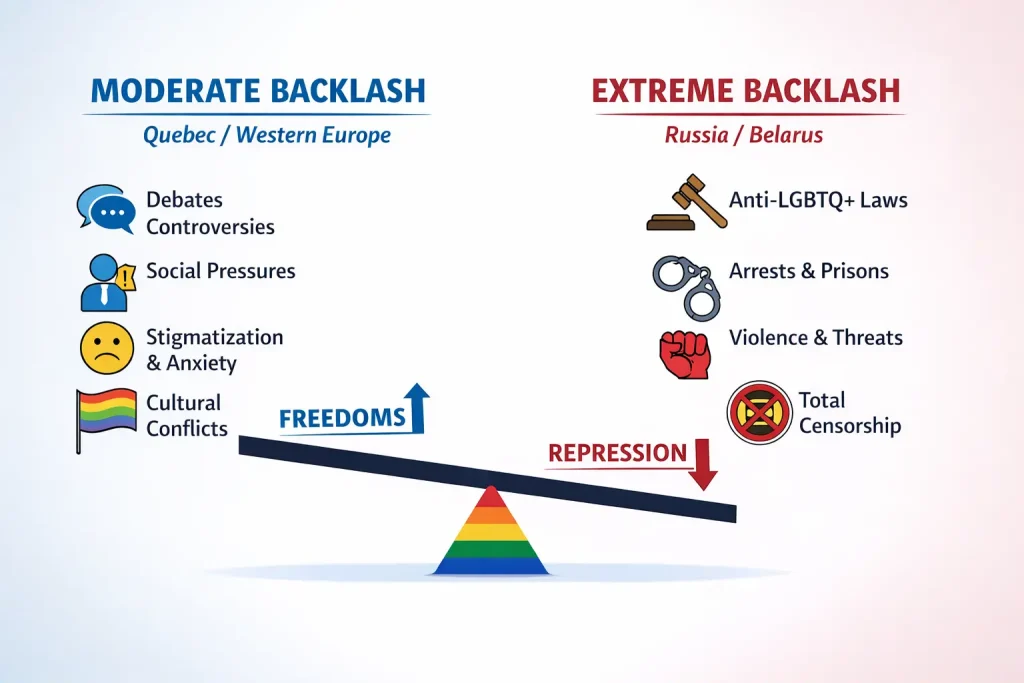
In Russia, since the adoption of the federal law in 2013 banning “LGBT propaganda” to minors, repression has intensified. This law is used to censor media, limit public events, and criminalize any form of LGBTQ+ visibility or education. Activists, artists, and ordinary LGBTQ+ citizens face fines, arrests, and, in some cases, violence. Russian society, supported by a conservative and Orthodox political stance, demonstrates a radical backlash after limited but gradual LGBTQ+ visibility in the 1990s and 2000s.
In Belarus, the situation is similar. There is no legal recognition of same-sex couples, and any initiative supporting LGBTQ+ rights is heavily repressed by the state. The war in Ukraine and the tightening of the regime have exacerbated control measures, with arrests and persecution targeting LGBTQ+ activists, making any public expression extremely risky.
Effects of backlash on homosexual individuals
A backlash has multiple and often very concrete effects on homosexual individuals, legally, socially, and psychologically.
On the legal level, it can mean the removal or restriction of recently acquired rights. This includes banning marriages or civil partnerships, restrictions on adoption, censorship of educational or cultural content, and even laws criminalizing certain public expressions of sexual identity. In countries such as Russia or Belarus, this can go as far as criminal penalties or arrests for activities deemed “LGBT propaganda.”
On the social level, backlash often leads to increased stigmatization, discrimination, and violence. Homosexual individuals may find themselves marginalized, subjected to harassment in the workplace, at school, or in the streets, and see their social lives restricted by fear of retaliation.
On the psychological and emotional level, this regression causes constant stress, anxiety, a sense of insecurity, and sometimes depression. Increased visibility can paradoxically become dangerous, pushing some individuals to hide or give up certain activities to protect their safety.
Backlash in Quebec and Western Europe
In Quebec, despite advanced laws on marriage equality, adoption, and protection against discrimination, certain debates reveal a slight reverse swing. For example, discussions about the participation of trans people in sports, inclusive education, or accommodations related to gender identity can create tensions in public opinion. Although repression is virtually nonexistent, these debates can generate stigmatization, a sense of misunderstanding, and sometimes fatigue among activists and LGBTQ+ individuals.
In Western Europe, countries such as France, Germany, or the Netherlands face a similar context: legal rights are largely secured, but the rise of conservative or populist movements can provoke counter-discourses, critical media campaigns, or social pressures. For example, the issue of religious accommodations versus LGBTQ+ rights is regularly highlighted in public debates, or certain political parties seek to limit LGBTQ+ visibility in schools or popular culture.
In these contexts, the effects of the pendulum are therefore mainly psychological and social: rising anxiety, polarizing public debates, stigmatization in certain environments, and the need for LGBTQ+ organizations to continue defending visibility and education. Unlike Russia or Belarus, the setback is not systematically legal or violent, but it serves as a reminder that progress is never guaranteed and requires constant vigilance.
ADVERTISING

REASD ALSO:
Social Media Regulation: Germany, France, China and Other Countries Tighten Controls
This article examines how several governments are expanding digital regulation to fight fake news, online disinformation, and harmful content — including control measures that intersect with LGBTQ+ safety, media integrity and online civil discourse.
🔗 https://gayglobe.net/social-media-regulation-germany-france-china/
2. Death Penalty and Persecution: Uganda, a Hell for LGBT People
A hard-hitting report on the severe legal repression facing LGBTQ+ people in Uganda, where recent laws impose brutal penalties, including life sentences and criminalization of advocacy and same-sex relations.
🔗 https://gayglobe.net/category/local-and-international-english-news/
3. When a Simple Online Form Sparks a Historic Lawsuit
This piece analyzes how disputes over gender identity and business compliance can escalate into broader legal battles that influence public perception of LGBTQ+ rights and community credibility.
🔗 https://gayglobe.net/gender-identity-vs-business-when-a-simple-online-form-sparks-a-historic-lawsuit/