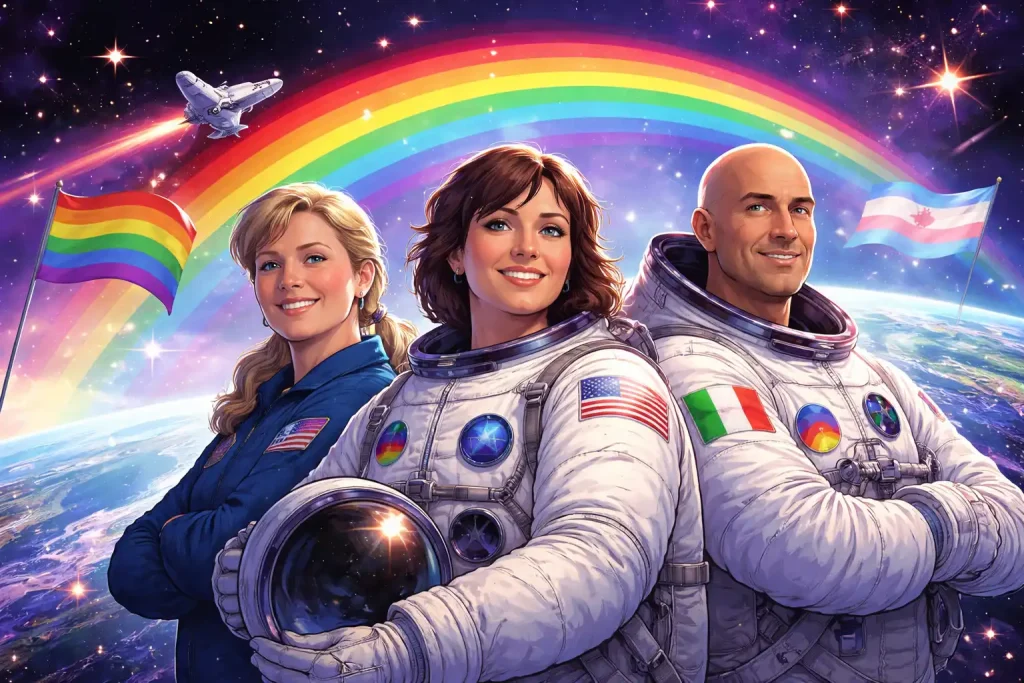
Carle Jasmin (Image : AI / Gay Globe)
I have often wondered whether gay, lesbian, or transgender people had ever been to space. For a long time, I thought it simply couldn’t exist. Then, after doing a bit of research, the surprise: yes, men and women from the LGBT communities have indeed participated in major space missions — and not just for a few minutes, but at the heart of historic programs.
Sally Ride: First American in Space and an Unintentional LGBT Icon
There are destinies that seem written in the stars. Sally Ride’s journey, however, began quite simply on May 26, 1951, in Los Angeles. A brilliant child and accomplished athlete — at one point considering a professional tennis career — she ultimately chose physics. At Stanford, she earned a PhD in astrophysics. An already impressive trajectory.
In 1977, she responded to a small ad: NASA was recruiting astronauts. Among more than 8,000 applicants, she was selected. In 1983, aboard the Challenger shuttle, she became the first American woman in space. At 32, she embodied a scientific, ambitious, modern America. Facing sometimes sexist media questions, she maintained calm and humor. She was there to work, not to play a role.
She returned to orbit in 1984 and later participated in investigation boards for the Challenger and Columbia disasters. A respected scientist and dedicated educator, she founded Sally Ride Science to encourage young people — especially girls — to pursue careers in science.
Another dimension of her story would only become known after her death. For nearly thirty years, she shared her life with Tam O’Shaughnessy. Their relationship remained private. In the 1980s, being openly lesbian within a federal institution tied to the military could have derailed a career.
At her passing in 2012, her obituary mentioned her 27-year partner. No activist statement, no public announcement. Just the truth. Sally Ride thus became the first known American astronaut to be lesbian, a revelation that adds a new depth to her legacy.
Anne McClain: An Openly Lesbian Astronaut of a New Generation
With Anne McClain, we move into a different era. Born in 1979 in Spokane, she first chose the military. A West Point graduate and combat helicopter pilot in Iraq, she accumulated honors and degrees, including a master’s in aerospace engineering. In 2013, she was selected by NASA.
In December 2018, she launched toward the International Space Station. She spent 204 days in orbit and completed two spacewalks. Military discipline, scientific precision, and composure: she embodies the modern rigor of astronauts.
Unlike the previous generation, Anne McClain is openly lesbian. Her orientation is neither a secret nor a manifesto. She speaks about it naturally. This simple fact marks a major shift: a few decades earlier, it could have jeopardized a military and space career. Today, it is part of an identity fully assumed.
Her visibility helps normalize the presence of LGBT people in space exploration. Less spectacular than a rocket launch, but just as significant.
Luca Parmitano: An LGBT Ally in European Space
Luca Parmitano’s case is different but equally interesting. An Italian astronaut of the European Space Agency, fighter pilot, and engineer, he completed his first mission in 2013. In 2019, he became commander of the International Space Station, a first for an Italian.
He is not homosexual but has stood out as an ally of LGBT communities. On social media, he has shown support for Pride and LGBTQ+ rights. A gesture that may seem simple, yet carries particular weight in a field long seen as conservative, and coming from a high-ranking military officer.
From orbit, borders disappear. His vision of a united humanity naturally aligns with values of equality and inclusion.
Have There Been Any Transgender Astronauts?
To date, no astronaut, cosmonaut, or taikonaut openly transgender has flown in space.
No major agency — NASA, ESA, Russian, Chinese, or Canadian space agencies — has confirmed the presence of a transgender person among its astronauts on orbital missions. This does not mean it will never happen. Medical and psychological criteria have long been extremely restrictive, making access nearly impossible for transgender people in the past.
Today, non-discrimination policies have evolved. With the rise of the private space sector, notably at SpaceX and Blue Origin, the profiles of future space travelers could become more diverse.
It is therefore likely that an openly transgender person will participate in a space mission in the coming years. The history of space continues to be written — and it is gradually becoming more inclusive.
ADVERTISING

READ ALSO:
Are ‘gay’ and ‘homosexual’ the same? Here’s what we found.
An article exploring how the words “gay” and “homosexual” differ in usage, social meaning, and political impact, including historical context and how language can influence public opinion on LGBT rights.
🔗 https://gayglobe.net/are-gay-and-homosexual-the-same-heres-what-we-found/
What does two‑spirit mean in the LGBT context?
Explains the Two‑Spirit identity within Indigenous North American cultures, detailing its cultural roots, meaning, and significance for understanding gender and sexuality beyond Western frameworks.
🔗 https://gayglobe.net/what-does-two-spirit-mean-in-the-lgbt-context/
Gay Globe Media will publish the communications of Fierté Montréal Pride
A press release in English announcing that Gay Globe Media will host communications from the Fierté Montréal Pride festival on a dedicated section of the site, expanding visibility for Pride events year‑round.
🔗 https://gayglobe.net/gay-globe-media-will-publish-the-communications-of-fierte-montreal-pride/