Roger-Luc Chayer (Image : AI / Gay Globe)
A New Virus in India Under Health Surveillance
A new virus has recently emerged in India, and although little is still known about Nipah, its mortality rate is estimated to be nearly 75%, prompting the Indian government to place the country under close health surveillance.
What is the Nipah Virus?
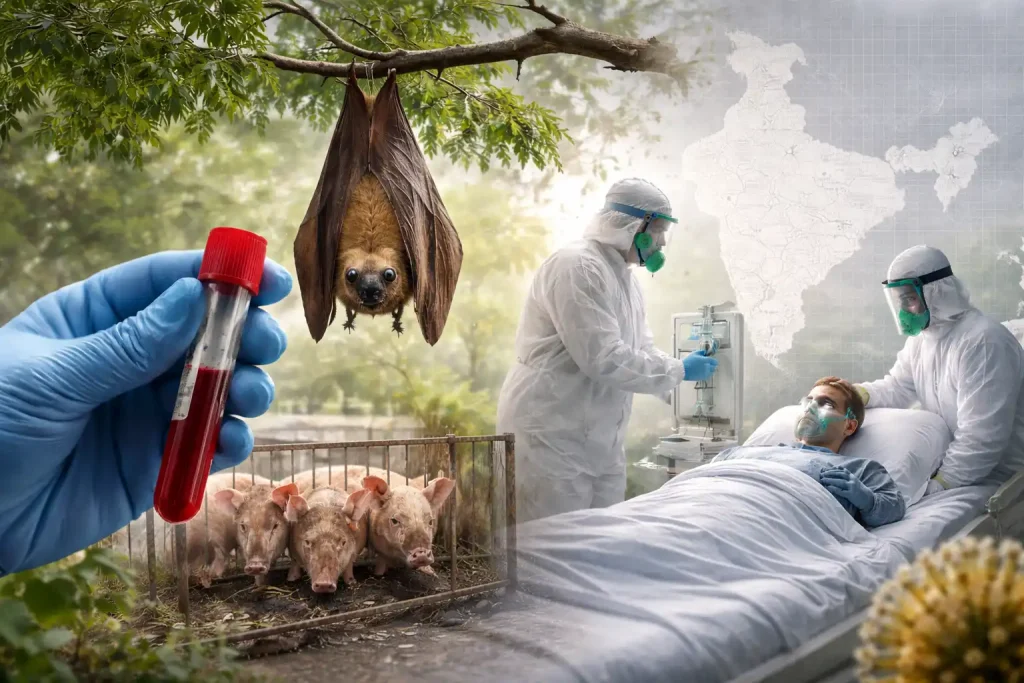
The Nipah virus is a rare but extremely serious zoonotic virus, first identified in 1998 in Malaysia during an outbreak affecting pig farmers. It belongs to the Paramyxoviridae family and is primarily transmitted to humans from fruit bats, which are its natural reservoir, either directly through contact with their secretions, or indirectly through intermediate animals such as pigs or by consuming contaminated foods, notably raw palm sap. Human-to-human transmission is also possible, especially in healthcare settings or through close contacts.
Symptoms and Mortality Rate of Nipah
In humans, infection can cause highly variable symptoms, ranging from a flu-like syndrome with fever, headaches, and fatigue to much more severe forms such as acute encephalitis leading to neurological disorders, seizures, coma, and sometimes death. The mortality rate is particularly high, often ranging between 40% and 75% depending on observed outbreaks, making it one of the most concerning emerging viruses worldwide.
Treatment, Vaccine, and Prevention
Currently, there is no specific antiviral treatment or widely available vaccine against the Nipah virus. Management relies on supportive care and prevention, notably by reducing contact with infected animals, maintaining food hygiene, and enforcing strict infection control measures during outbreaks. Due to its danger and pandemic potential, the Nipah virus is among the pathogens closely monitored by international health authorities.
Can the Nipah Virus Travel from One Country to Another?
The Nipah virus can theoretically travel from one country to another, but not in the same way as a highly contagious respiratory virus like influenza or COVID-19. Its international spread is mainly possible through the movement of infected individuals during the incubation period, which can last from a few days to about two weeks, or even longer in rare cases. A person can therefore travel without symptoms and become ill after arriving in another country.
That said, Nipah does not transmit easily. Human-to-human transmission generally requires close and prolonged contact, particularly with bodily secretions, which greatly limits its large-scale spread. Outbreaks observed so far have remained localized, often in South Asia, and have not led to sustained international propagation.
The risk thus exists but is considered low under current conditions, especially in countries with effective health surveillance systems. This is precisely why health authorities closely monitor Nipah cases: not because it spreads easily, but because its high lethality makes it a high-risk virus if its transmission modes were ever to evolve.
Comparison Between the Nipah Virus and COVID-19
Both the Nipah virus and COVID-19 are zoonotic viruses, meaning they are transmitted to humans from animals, but their behavior and impact are very different. Nipah is much more deadly, with a fatality rate that can reach 70 to 75%, whereas COVID-19’s is significantly lower. In contrast, COVID-19 spreads much more easily, primarily through airborne transmission, which allowed it to spread rapidly worldwide, unlike Nipah whose human-to-human transmission remains limited and requires close contact with bodily fluids.
Clinically, COVID-19 mainly affects the respiratory system, though it can impact many organs, whereas Nipah frequently causes severe neurological damage, including encephalitis that can lead to permanent disabilities or death. Nipah’s incubation period can be longer and less predictable, complicating surveillance, but the low number of cases and nature of contacts needed limit its spread.
Is There a Vaccine Against the Nipah Virus?
There is currently no approved, licensed, or widely available vaccine against the Nipah virus, although experimental vaccines are in development and undergoing clinical trials. Global health authorities confirm that at present no vaccine is authorized to prevent infection in humans: prevention efforts rely on public health measures and precautions to avoid exposure to the virus.
ADVERTISING
