Opinion by Roger-Luc Chayer (Photos : Roger-Luc Chayer / Gay Globe)
The Last Man on Earth
The Last Man on Earth – Montreal’s Gay Village in Crisis
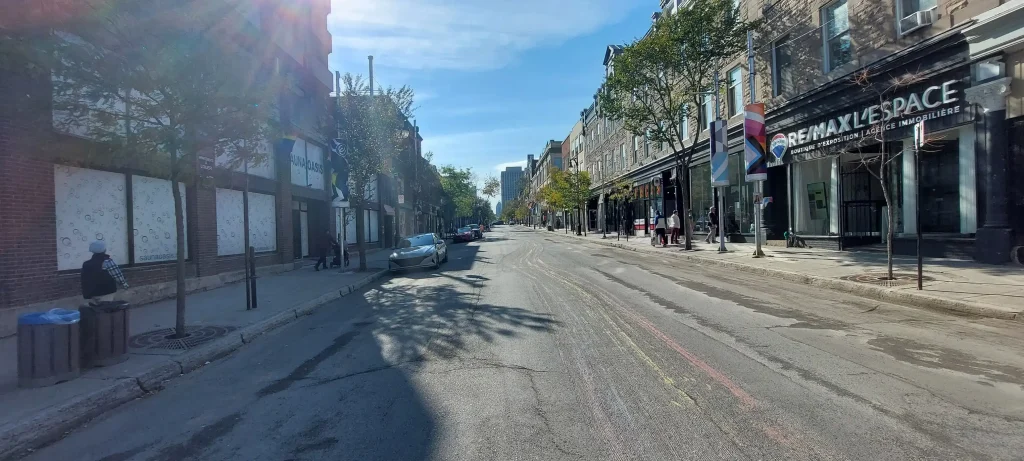
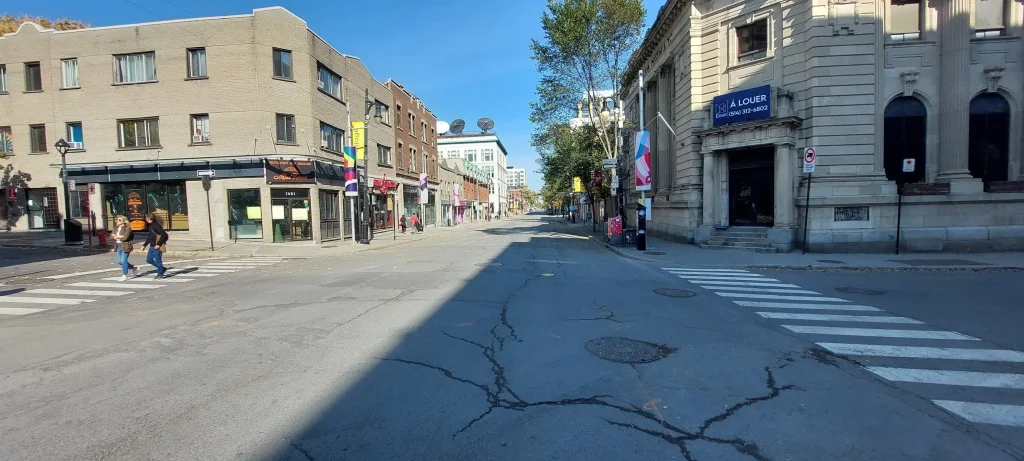
On Sunday, October 19, 2025, alone, I wandered through the heart of the chic Montreal Gay Village, my heart heavy. Some compared my photos to the atmosphere of Daisy Town in Lucky Luke, with its deserted Montreal streets seeming ready to host a Western drama. Others saw an echo of the film The Last Man on Earth, with Vincent Price, as they observed Sainte-Catherine East, between Saint-Hubert and Papineau, a historic street in the Gay Village.
Even the usual urban wildlife — lost silhouettes normally encountered, urban zombies, people in drug crises, or roaming street gangs in Montreal — seemed to have vanished. The wind swept through the closed storefronts of the Gay Village, lifting forgotten papers like remnants of a finished celebration. Only the whisper of neon signs remained, witnessing a neighborhood once vibrant, now suspended in an eerie silence.
Montreal and The Last Man on Earth
In The Last Man on Earth, Vincent Price plays a lone man, the last survivor of humanity decimated by an epidemic that turned everyone else into nocturnal creatures. Every day, he wanders a dead city, emptied of all human warmth, searching for traces of a past long gone. At night, he barricades his house while the shadows of those he once loved roam outside. His existence becomes a desperate routine, made of memories, solitude, and hope slowly fading.
Like in The Last Man on Earth, I walk through a setting that has lost its voice. Vincent Price wandered among the ruins of a lifeless world; I do the same in the Montreal Gay Village, witnessing another form of extinction. Where laughter, music, and the echoes of a vibrant community once resounded, only closed storefronts, blinking signs, and the wind remain as my sole companions. He searched for survivors in the rubble of a lost civilization; I search for mine in the neon reflections that no longer know whom to smile at. In this heavy silence, the line between fiction and reality blurs, and the Gay Village itself seems transformed into a deserted stage, where the last role left to play is that of the survivor—me.
I do not mean to suggest that the Montreal Gay Village is completely dead. Many businesses still thrive. I think of the main investor, Danny Jobin, with his District Video Lounge, Stock Bar, Weiser, or Club Date. I think of people like Régis of La Mie Matinale bakery, whose scent of fresh bread floats between De Champlain and Papineau, or the Évolution Boutique, which decorates its windows as if it were Christmas every day. But the further west you go along what was once the majestic Sainte-Catherine Street, the more visible the scars become. Scars left by twelve years of political decisions in Montreal that deeply wounded my Village.
Photos that Speak
The two photos at the top of this article speak for themselves. If an image is worth a thousand words, these cry out thousands more — heart-wrenching cries frozen in silence from the Montreal Gay Village.
After delivering a small flyer to La Mie Matinale, I parked around 1:20 PM on Plessis Street, at the corner of Sainte-Catherine. Crossing the street, I was struck by an immense emptiness. I heard nothing: no cars, no bikes, not even the murmur of a few hurried pedestrians.
The wind rose and lifted the dust of the erased paint that once decorated the street. My eyes were full — literally and figuratively — because, in addition to no longer seeing the Gay Village as it was, I had to avert my gaze to avoid crying.
That Was Not the Plan
In the golden years of the Montreal Gay Village, there was something in the air, fragile yet vibrant. Gay and lesbian communities left their marks there, not to dominate, but to exist, so that the space reflected them, so people could find themselves and recognize one another. The Village was meant to be a refuge and a mirror, a place where light and music could erase, if only for a moment, the pressures of the outside world.
Every street, terrace, and storefront expressed this gentle urgency: to be there together, to make our lives feel significant, to assert that our loves had a place. This neighborhood carried the nostalgia of hard-won achievements and the certainty that, even in the shadows, a space could become a sanctuary of freedom and beauty.
Denis Coderre and Valérie Plante: Architects of the Gay Village’s Ruin
Here are the names responsible for the current degradation. Two names to remember, with the complicity of a third, Robert Beaudry, who, confronted with every new catastrophe reported by residents and business owners, cloaks himself in irritating joviality, as if mocking those still hoping he will act. Why not? Beside him, Mayor Plante and he, the main elected official capable of at least trying, seem to wash their hands of the situation, letting the Gay Village sink under orchestrated indifference.
The responsibility of Denis Coderre and Valérie Plante for the current crisis in the Montreal Gay Village is not the result of a single event, but a series of political decisions and priorities that cumulatively transformed the neighborhood and weakened its community fabric. Under their respective terms, urban planning, commercial development, and regulatory choices favored gentrification and the alteration of public spaces at the expense of historic residents and the businesses that formed the Village’s soul. Rents and taxes increased, iconic businesses were forced to close or adapt, and initiatives meant to protect cultural vitality were often insufficient or poorly coordinated.
This is not merely a question of daily management, but of misaligned priorities: while the Gay Village should remain a lively, inclusive, and safe space for the LGBTQ+ community, mayoral decisions often favored real estate development or spectacle projects, leaving residents and business owners to fend for themselves against social decay. The result is a neighborhood whose face has changed, where population density has dropped, local businesses close, and the sense of belonging and security, fundamental for the Village, gradually erodes.
November 2: Election Day in Montreal
The only thing that can still save what remains of the Gay Village is to vote on November 2. Vote to punish those who destroyed this neighborhood, so they finally understand what their indifference, compromises, and arrogance have cost. Vote to end this farce and try to give a new administration a chance to repair the damage, even if the destruction is immense and the neighborhood has been bleeding for too long. Enough empty speeches, enough hypocritical smiles: it is time for those responsible to pay and for the Gay Village to regain a piece of life.
ADVERTISING

résident du village depuis au delà de 30 ans, c’est vrai que ça fait dur. Il semble claire que les seules entreprises que survivent, sont ceux au l’exploitant et aussi le propriétaire de la bâtisse. Les rumeurs veulent que la fameuse taverne du village a fermé après les exploitantes ayant une loyer de 30.000$ par mois, voyaient le loyer augmenter de 1000$ par mois à chaque année. Rendu à 34.000$ elles n’ont pas renouvelés leurs bail et c’était la fin de 3 étages et des mezzanines gigantesques, fermé pour toujours.
Bonjour Peter, merci pour votre commentaire. Pour le Drugstore et la taverne du Village, que j’adorais surtout pour le plafond de verre, j’avais une autre explication pour sa fermeture, mais évidemment comme ce sont des rumeurs, on ne peut en parler publiquement:) À bientôt.