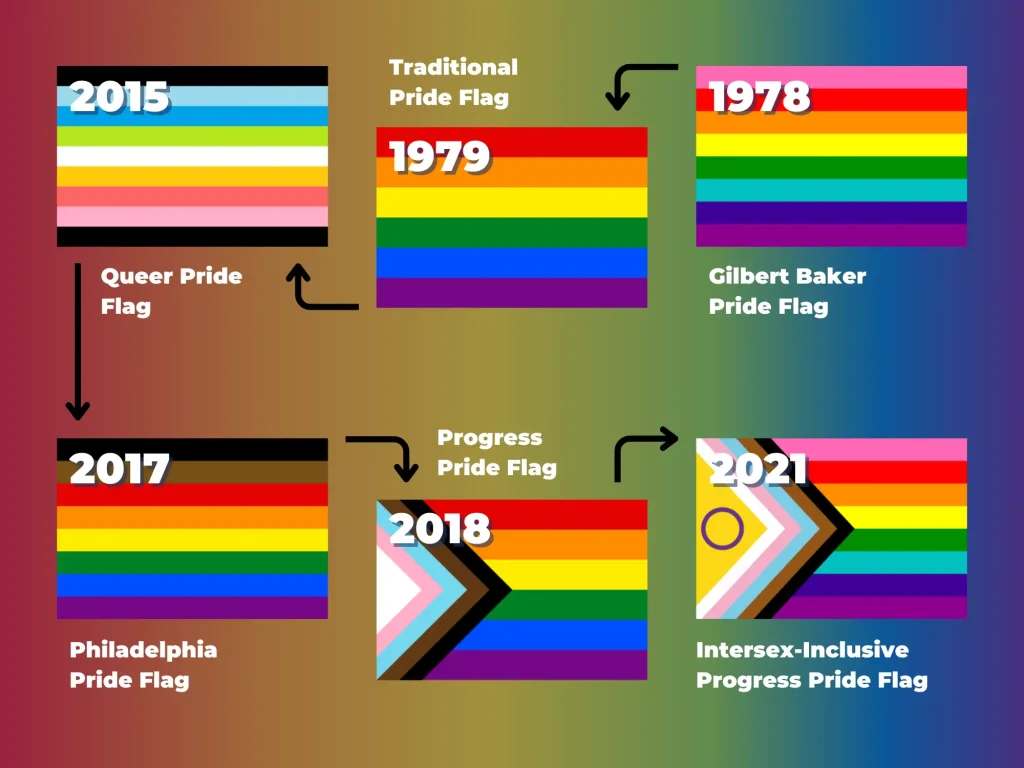
Roger-Luc Chayer (Images : Wikipedia)
The History and Evolution of the Gay Flag
The history of the gay flag and its evolution seems to follow a path parallel to that of the acronym, which at first stood for Gays and Lesbians but has now become somewhat exaggerated with a multitude of letters, the meanings of which even members of these communities often do not know.
We recently discussed this in an article titled The Evolution of the LGBT Acronym: Meanings, History, and Debates.
Origins of the Rainbow Flag
The first gay flag, more precisely the rainbow flag now globally associated with LGBTQ+ communities, was created by American artist and activist Gilbert Baker in 1978 in San Francisco. He designed it at the request of Harvey Milk, one of the first openly gay elected officials in the United States, in a context of strong mobilization for the visibility and rights of homosexual people.
The original version of the flag had eight colors, each carrying symbolic meaning, ranging from sexuality to spirit, including healing and harmony. For practical reasons related to production and fabric availability, the flag was later simplified to six stripes, a configuration that became widely established and is now the universal emblem of the LGBTQ+ movement.
Gilbert Baker saw this flag not as a mere identity symbol, but as a political and cultural symbol of diversity, pride, and collective emancipation.
Symbolism of the Colors
Contrary to popular belief, including within these communities, the original eight colors had nothing to do with sexual orientations but rather reflected a philosophical dimension.
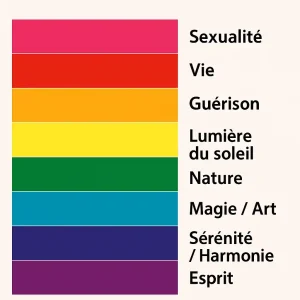
Meaning of the Original Eight Colors
In the subsequent six-color version of the rainbow flag, the one most widely recognized and established from the late 1970s, red symbolizes life, understood as a fundamental energy common to all; orange represents healing, both individual and collective; yellow evokes sunlight, associated with joy, clarity, and hope; green represents nature and the idea of balance; blue, resulting from the merging of the former turquoise and indigo bands, embodies serenity and harmony; while purple remains linked to spirit, in a broad sense touching on the inner, cultural, and symbolic dimension of existence.
All of this indeed belongs to an esoteric symbolism, far removed from any direct reference to sexual orientations. From there, everything degenerated, leading in 2021 to a flag that encompasses so many realities that it no longer means much to LGB individuals.
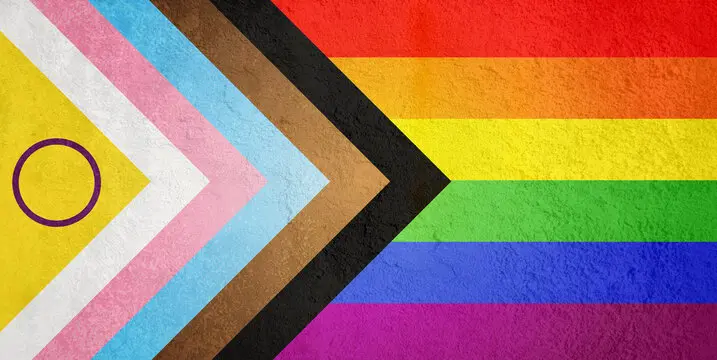
Flag Supposed to Represent LGBTQ+ Communities in 2026
The Progress Pride Flag in 2026
This flag is a so-called “Progress Pride” version, combining the six-color rainbow flag with several symbolic additions appearing from 2018 onward and formalized in versions distributed in the early 2020s. The traditional six horizontal stripes retain their meanings inherited from Gilbert Baker. Added to this is a chevron pointing to the right, meant to signify progress and movement.
Within this chevron, black and brown represent racially marginalized people within LGBTQ+ communities as well as the memory of those who died from HIV/AIDS, highlighting issues of racial discrimination and social justice. The light blue, pink, and white derive from the transgender flag and respectively refer to trans men, trans women, and people whose gender is in transition, non-binary, or neutral. Finally, the purple circle on a yellow background, from the intersex flag, symbolizes bodily autonomy and the integrity of intersex people.
The whole no longer relies on a general philosophical symbolism as originally, but on a logic of explicit inclusion of specific groups, each color or shape now corresponding to a particular category or social reality.
Reactions and Controversies
The Progress Pride Flag, although adopted by a large part of the LGBTQ+ community, is not unanimous. Some indeed prefer the traditional rainbow flag, which they find simpler, more universal, and rich in history. Others criticize this revised version, believing it complicates a symbol that should remain accessible and easily identifiable. Moreover, debates persist regarding the representation of certain specific communities, notably Black and Latinx people, which is sometimes judged insufficient. Finally, in some circles, this flag is accused of being co-opted for commercial or marketing purposes, which risks diluting its activist message.
Personal Observation
In my personal and professional experience, I have asked several people from gay and lesbian communities about the meaning of the most recent flag, and none could even begin to identify the traditional colors. By trying to do too much, one ends up losing the very essence of the symbol.
ADSVERTISING
