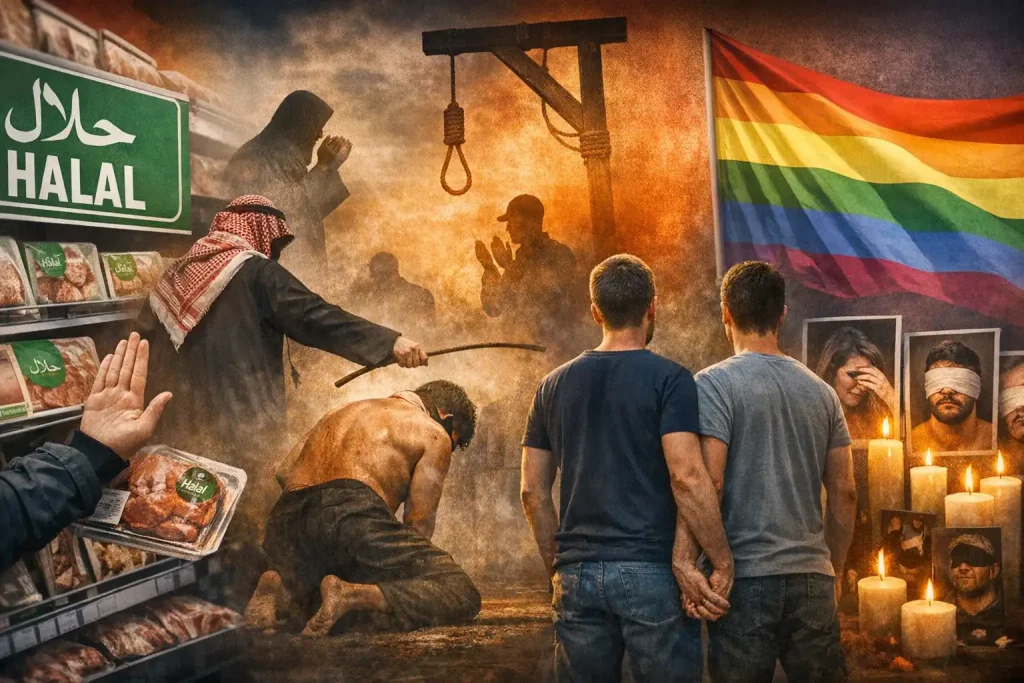
Opinion by Roger-Luc Chayer (Image : IA / Gay Globe)
The growing presence of halal products in our grocery stores
We increasingly see products labeled “halal” on the shelves of our grocery stores. It is important to understand its meaning, as well as the reasons why this label can be perceived as incompatible with certain minorities within society.
What does the term “halal” mean?
The term “halal” is an Arabic word meaning “lawful” or “permissible.” In the context of food, it designates products that comply with the prescriptions of Islam. These rules concern both the nature of the foods and the way they are produced, processed, and prepared. For meats, the halal status notably involves a specific ritual slaughter performed according to strict religious rules, including an invocation and a particular method aimed at making consumption compliant with the Muslim faith.
The halal slaughter ritual
The halal slaughter ritual is based on precise religious prescriptions derived from Islam, aimed at making the meat lawful for consumption. The animal must be alive and healthy at the time of slaughter. The person performing the act, generally Muslim, pronounces an invocation dedicated to God just before cutting. The slaughter consists of a quick and clean incision of the throat, severing the respiratory tracts, esophagus, and major blood vessels to cause abundant bleeding.
This bleeding is considered essential because blood is deemed impure and must not be consumed. The act must be performed with a sharp instrument, with the intention of minimizing the animal’s suffering. Depending on religious interpretations and local practices, pre-stunning may be accepted or rejected, a point that remains debated among Muslim religious authorities.
More broadly, the concept of halal is not limited to food: it extends to all daily life actions, opposed to the term “haram,” which designates what is forbidden according to Islamic law.
The term “halal” and gays
When conducting deeper research on the term “halal,” one discovers that this ritual, originating from the Muslim religion, is perceived by some as completely incompatible with the very recognition of LGBT communities.
The perception of incompatibility between Islam and homosexuality primarily stems from traditional interpretations of religious texts. In classical Islam, the Quran and hadiths are mostly understood as condemning sexual relations between people of the same sex, particularly through the story of the people of Lot, often interpreted as an explicit denunciation of homosexuality. This reading has shaped, over the centuries, a legal and moral framework in which homosexual relationships are considered illicit, just like other behaviors deemed contrary to religious moral order.
It is, however, essential to distinguish religious doctrine from its social and political practices. Islam is neither monolithic nor fixed, and positions vary according to legal schools, cultures, and historical contexts. While dominant interpretations remain largely hostile to recognizing LGBT identities and relationships, contemporary Muslim voices—whether theologians, intellectuals, or believers—today offer alternative readings emphasizing justice, human dignity, and non-discrimination.
Does Islam still sentence homosexuals to death?
In most Muslim-majority countries today, the execution of individuals simply “for being homosexual” is generally not systematically practiced, but in several Muslim-majority countries, the law still officially provides for the death penalty for homosexual acts, even if these sentences are not always concretely enforced.
In certain states where the law is based on strict interpretations of the Sharia (Islamic law), texts still prescribe the death penalty for sexual relations between people of the same sex. This is the case, for example, in Saudi Arabia, Iran, Yemen, Mauritania, Qatar, the United Arab Emirates, and certain regions of Nigeria, all of which are among the countries where death is listed as a possible punishment for this type of offense in penal codes inspired by Sharia.
That said, there is a significant difference between written law and what actually happens on the ground today. In many of these countries, although the death penalty is theoretically still provided for, no official executions for homosexuality alone have been recently documented, and in some cases, authorities opt for penalties such as imprisonment, lashes, or other sanctions. For example, in Mauritania, the death penalty still exists in the law for men, but no recent executions have been confirmed, and a de facto moratorium is observed.
In other countries, such as the province of Aceh in Indonesia, men have been physically punished (by caning) for homosexual acts, but this is not a capital execution.
Why is eating “halal” perceived by some as a lack of respect toward LGBT people and oneself?
In any case, if one understands the logic of grocers and major food chains, it would seem they want to offer homosexuals “halal” products—that is, to make money off them—even though the production of this food and the philosophy behind this label rest on a religious framework that does not recognize the right of homosexual people to the most basic respect. In several countries claiming these interpretations, LGBT people are still prosecuted, imprisoned, whipped, publicly humiliated, or even executed, not to mention systemic stigmatization in access to education, employment, and daily life. This reality is often relativized or minimized on the grounds that these practices do not occur in Western countries, as if geographical distance were sufficient to erase the moral contradiction.
Personally, I always carefully check packaging and watch for the “halal” label. I systematically refuse to buy these products and, even more, to give my money to a religious gesture I consider disrespectful to me, which does not even recognize me as a human being entitled to dignity. This seems all the more problematic to me in Quebec, a nation born of the Quiet Revolution, where, since the 1960s, religion has been removed from the public sphere, notably hospitals, schools, and state institutions.