Roger-Luc Chayer (Image : AI / Gay Globe)
When Ridicule No Longer Kills, It Takes Residence in Weak Minds and Thinks It’s King
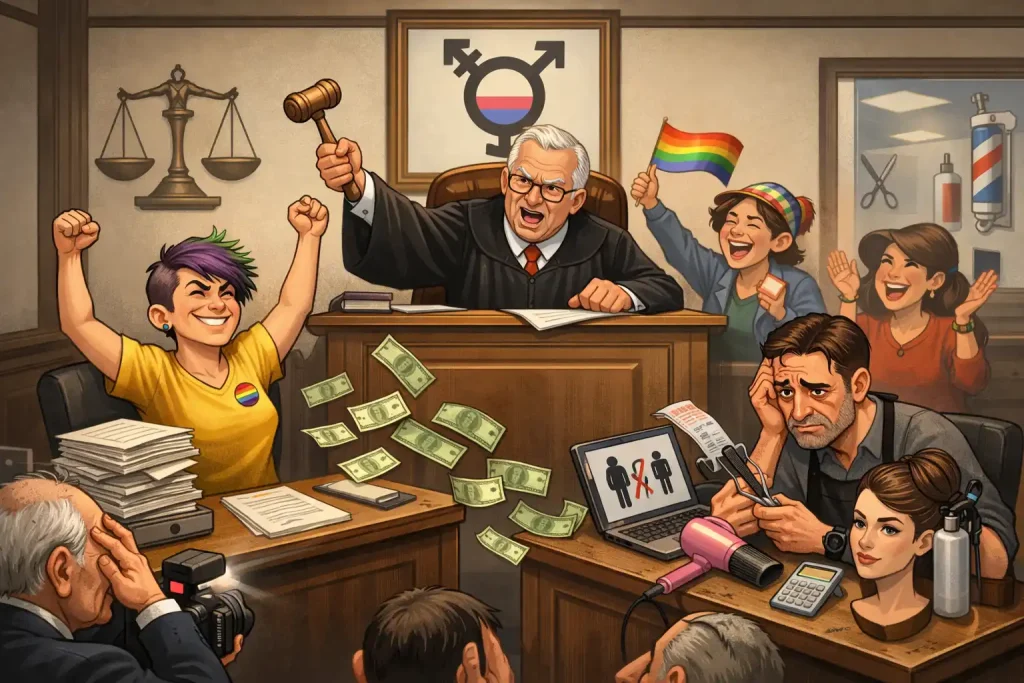
This is somewhat the feeling we experience following this ruling by the Tribunal des droits de la personne et des droits de la jeunesse, rendered after a lawsuit filed by a non-binary person who demanded that a hair salon in Longueuil offer gender-neutral haircuts to non-binary clients—and iel (this is not a typo) won.
A Decision Redefining Equal Access to Hairdressing Services in Quebec
The Quebec Human Rights Tribunal has issued a landmark decision regarding discrimination based on gender identity in access to publicly offered services. The case pits a non-binary individual against a hair salon whose online booking system required clients to choose between a “men’s service” or a “women’s service.”
At the heart of the dispute is whether this categorization constitutes a violation of the right to equality guaranteed by the Charter of Human Rights and Freedoms.
Booking Impossible Without Selecting a Gender
The complainant, who identifies as non-binary, wanted to book a haircut online. However, the electronic form required a prior choice between two gendered categories. Refusing to identify as male or female, the person tried to bypass the obstacle by contacting the business by phone and visiting in person, without success.
The salon’s business model relied exclusively on online reservations, offering a discounted rate to clients who booked in advance. Walk-in customers had to pay a significantly higher fee.
The complainant argued that this structure created a real barrier and a financial disadvantage for non-binary individuals who refused to conform to the male/female categorization.
Legal Framework: Discrimination and Public Services
The lawsuit was based on Articles 10 and 12 of the Quebec Charter, which prohibit discrimination in the full and equal exercise of rights and freedoms, including the conclusion of contracts for goods or services offered to the public.
The Tribunal applied the test established by the Supreme Court of Canada in Quebec (Commission des droits de la personne et des droits de la jeunesse) v. Bombardier Inc., requiring proof of:
- a distinction based on a protected ground;
- a real effect compromising the exercise of a right;
- the existence of harm.
The Tribunal concluded that the first two criteria were met: the distinction was clearly based on gender identity, and it created a concrete disadvantage regarding pricing and access to service.
Absence of Reasonable Accommodation
The business argued that it had never refused to cut the complainant’s hair and had offered them the choice of any category.
The Tribunal rejected this argument. Requiring a non-binary person to check “male” or “female” does not constitute reasonable accommodation. The ruling reminds that businesses must consider adaptation measures to ensure equality in service access, except in cases of undue hardship.
Drawing on the BC case Public Service Employee Relations Commission v. BCGSEU (Meiorin), the Tribunal found that a simple solution was possible: allow booking without gender categorization or apply the online rate despite the absence of a formal reservation.
A few months after the incident, the salon updated its system to include a “non-gendered” option.
Damages Awarded
The complainant requested $12,500 in material, moral, and punitive damages.
The Tribunal rejected the claim for lost wages, citing lack of proof of a causal link between the incident and a subsequent work absence. Punitive damages were also denied, as there was no evidence of malicious intent.
However, $500 was awarded for moral prejudice, corresponding to the amount initially proposed by the Commission des droits de la personne et des droits de la jeunesse.
A Lawsuit Deemed Legitimate
The salon had filed a counterclaim for abusive litigation, seeking $5,000.
The Tribunal dismissed it, noting that the right to seek judicial remedies for fundamental rights is itself protected by the Charter. The mere fact that someone multiplies claims does not, in itself, constitute abuse.
Each party will ultimately bear its own costs.
A Decision with Wider Implications
Beyond the relatively modest amount, the decision establishes an important principle: even without a formal refusal of service, a commercial practice can be considered discriminatory if it creates a real obstacle or disadvantage for a protected group.
The ruling confirms that Quebec businesses must adapt their administrative and digital practices to ensure truly equal access to services offered to the public, especially regarding gender identity.
In a context where reservation and consumption processes are increasingly automated, this decision reminds us that the apparent neutrality of a computer system does not preclude the possibility of systemic discrimination.
Editor’s Note: The worst part is that the salon quickly corrected its website to offer non-gendered haircuts and took all required measures even before the ruling was pronounced, which seems grossly exaggerated. Nevertheless, the complainant persisted in their claim despite the salon’s good faith correction.
When Controversial Claims Undermine Public Perception of LGBT Communities
Every judicial decision involving gender identity or sexual orientation rights triggers debate and reaction. But when certain cases are perceived as excessive by a portion of public opinion, their impact extends beyond the legal framework. They can influence the overall perception of LGBT communities—sometimes negatively.
Rapid Generalization from an Isolated Case
In the media space and on social networks, a single dispute can quickly become a symbol. When a lawsuit is perceived as disproportionate, it is sometimes used to illustrate an alleged “drift” of diversity or gender identity claims.
The risk: an individual case may be extrapolated to the entire community. A plural and nuanced reality is thus reduced to a controversial example, feeding persistent stereotypes.
Fuel for Polarization
Highly publicized cases can intensify social polarization. On one side, defenders of fundamental rights stress that equality before public and private services is a clear legal principle. On the other, critics denounce what they see as over-legalization of daily life.
This divide makes dialogue more difficult, with debates crystallizing around emotion and perception rather than legal analysis or precise facts.
Public Opinion Fatigue
Some analysts also note a “social fatigue” phenomenon. As controversies multiply, some of the public may develop weariness or mistrust toward claims that are legitimate in principle.
This can indirectly slow support for concrete advancements or undermine the social consensus necessary for lasting rights protection.
Risk of Political Exploitation
Controversial cases can also be politically instrumentalized. Parties or activist groups may use them to mobilize their base, often simplifying or dramatizing the issues.
In this context, LGBT individuals can become the first victims of a debate that surpasses them, caught between partisan strategies and ideological conflicts.
Between Law and Public Perception
It is essential to remember that a judicial claim represents a fundamental right. Access to courts is a normal mechanism for resolving disputes in a democratic society.
The real challenge may lie less in the existence of these claims than in how they are presented, interpreted, and debated publicly. Nuanced and contextualized coverage is crucial to prevent individual cases from becoming collective shortcuts.
The names of the parties have not been mentioned in this article to avoid possible new legal proceedings from the complainant, who has already demonstrated a strong tendency to resort to courts to assert their rights, whether justified or not.
ADVERTISING