Roger-Luc Chayer (Image : AI / Gay Globe)
A recent Radio-Canada report stated that Gaspésie, a remote region of Quebec, was returning to print newspapers, and not just one. « Print newspapers are making a strong comeback in Gaspésie with the relaunch of three weekly publications by Publications gaspésiennes. The printed version of the newspaper will now be distributed by Canada Post at a rate of 10,000 copies per week. It had been closed in 2023, after 80 years of existence. »
The return to print for some, and the continued presence of print for others like the Gay Globe Magazine, is of critical importance, and it’s because — or thanks to — the Web, if you prefer.
The democratization of the Web and easy access for everyone allows the spread of massive amounts of misinformation, with practically no control from authorities to filter what is published, shared, or propagated. For this reason, the Web primarily serves to misinform and manipulate readers and users, who, in many cases, are too credulous and believe everything that is circulated online.
If we wonder why so much false information circulates on the Web, the answer is simple: it has become incredibly easy to spread. Unlike traditional media, where a text usually goes through multiple stages — drafting, revision, approval — the Internet allows almost anyone to publish anything in seconds. A keyboard, a connection, and an opinion are enough.
Social media further amplifies this phenomenon. Their algorithms favor content that triggers strong reactions: outrage, anger, surprise. A sensational piece of information, even if fabricated, often attracts much more attention than a well-verified story. As a result, fake news sometimes travels faster than the truth.
There is also an economic reality behind this. Some sites deliberately create questionable stories simply to attract clicks and generate advertising revenue. The more sensational the headline, the more readers it draws. And the more readers it draws, the more revenue it generates.
Many people share an article or post without verifying the source. If the content confirms what they already believe, they are more likely to accept it and click “share” almost automatically.
In a world as fast and open as the Web, disinformation finds an almost perfect environment. It’s a bit like the Wild West of information: everything circulates very quickly, sometimes for the better… but far too often for the worse.
Unlike the Web, the good old print media offers almost absolute security regarding the circulation of news.
Print media generally enjoys greater credibility because it relies on a structured editorial culture. In a printed newspaper or magazine, a text does not appear on the page simply because someone decided to publish it. It goes through multiple stages: drafting, revision, fact-checking, and editorial approval. This process acts as a filter.
Print also imposes a form of responsibility. Once a newspaper prints information, it becomes permanent. Errors cannot be corrected in seconds like on the Web. This permanence requires greater caution.
This is how things are done at Gay Globe. Everything published in the print magazine, and on our news feeds, undergoes the same process. Information is analyzed, corroborated, drafted, and then published. Once it is out, we live with it and take responsibility.
Print media remains extremely important for readers, who see it as serious and professional. Even though too many people believe everything they see on the Internet, print enjoys near-universal trust when it comes to determining whether information is legitimate.
The strength of the Gay Globe Magazine’s print edition lies in the credibility it inspires. Every text is considered, verified, revised, and assumed before printing. Once published, there is no “edit” button. This permanence builds readers’ trust.
Print also provides a symbolic value that digital does not always offer. A magazine that you hold, keep, and flip through immediately gives the content a more serious and lasting dimension.
The print edition also allows for more thoughtful and in-depth content. Where the Web prioritizes speed, the printed magazine emphasizes perspective and analysis, giving real depth to the topics covered.
The magazine becomes a cultural object and a witness of its time. Each issue is a tangible record of journalistic work and of the memory of the communities it covers.
As editor of the magazine, I often wondered whether it was time to go 100% digital. But after consulting partners and readers, I realized that a full digital shift would be almost like announcing the closure of the magazine, and the readers do not want that.
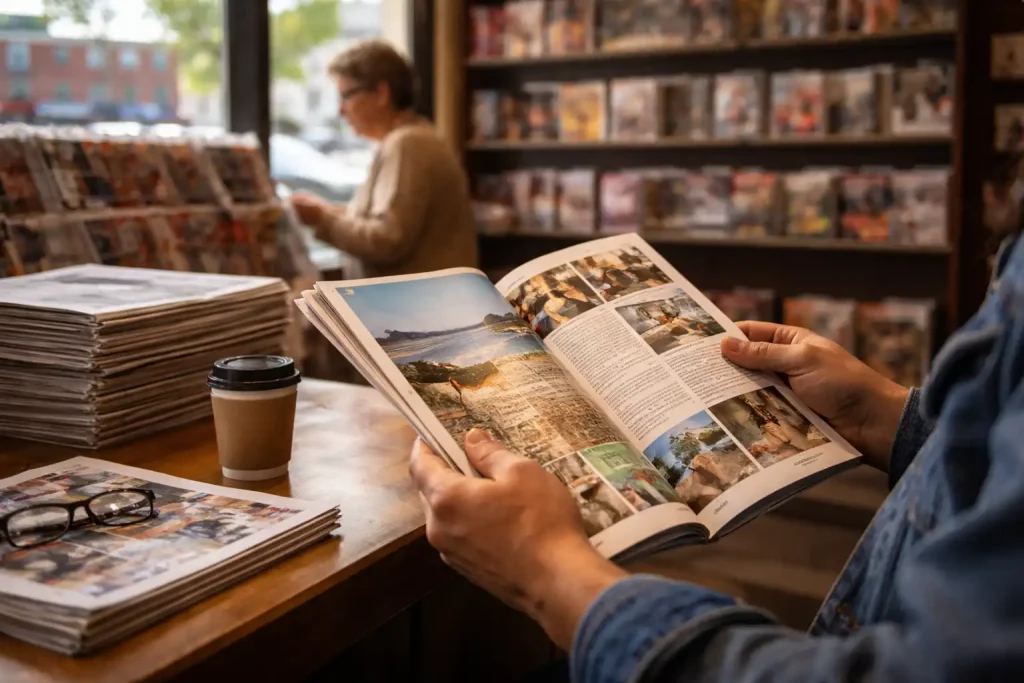
And then there is that little thrill when I walk into a store and see someone reading the magazine attentively. Without the print version, this reader would not have in their hands the result of a collective effort that makes us very proud of the Gay Globe Magazine.
PUBLICITÉ

READ ALSO:
Social Media Regulation: Germany, France, China and Other Countries Tighten Controls — This article discusses how various nations are tightening social media regulation to combat fake news and online disinformation, aiming to restore credibility and accountability in digital platforms.
🔗 https://gayglobe.net/social-media-regulation-germany-france-china/
LGBT Astronauts: Pioneers and Allies Who Made Space History — A feature from the Spot – Anglophone Newswire section highlighting LGBT pioneers in space exploration, touching on representation and media coverage of LGBTQ+ figures in science and history.
🔗 https://gayglobe.net/are-gay-and-homosexual-the-same-heres-what-we-found/ (linked from same list)
Global Backlash Against LGBTQ+ Rights — An analysis of how international political shifts and media narratives contribute to backlash against LGBTQ+ rights, including how digital discourse and media influence public perception and policy debates.
🔗 https://gayglobe.net/social-media-regulation-germany-france-china/ (linked from article listing)