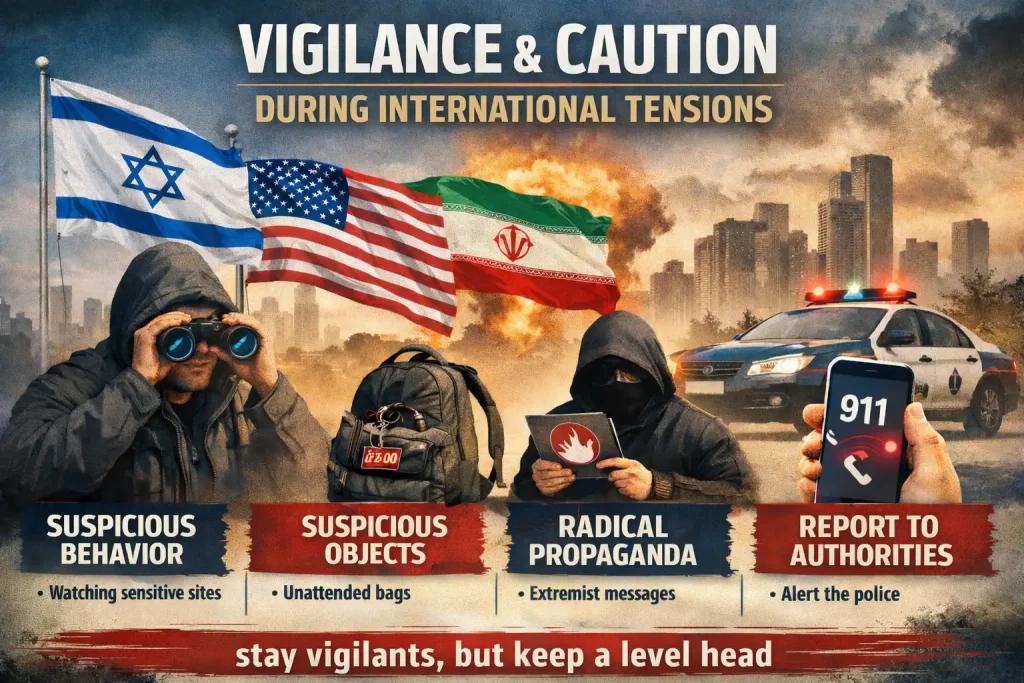
Arnaud Pontin (Image : AI / Gay Globe)
Maximum Caution in the Context of the Israel‑US‑Iran War
In the context of the war between Israel, the United States, and the Islamic Republic of Iran, several countries recommend the utmost caution in general, as historically Iran has often resorted to terrorist attacks in Western countries. And this applies even more to LGBTQ+ communities, which can be particularly targeted by terrorist acts.
Following our call for caution and awareness, a reader rightly asked: who should we be specifically wary of? What signs should we watch for? Here are some possible answers.
Who Should Be Watched and Which Signs Are Revealing?
In a context of international tensions, such as those involving Israel, the United States, and the Islamic Republic of Iran, it is natural to ask: who should we be wary of and which signs should we monitor? It is important to remember that vigilance does not mean targeting people based on their origin, religion, or appearance, but staying attentive to unusual behaviors or situations that could signal danger.
Suspicious Behaviors
Certain attitudes may indicate that someone is preparing or facilitating a malicious act. For example:
- Repeated or prolonged observation of sensitive locations: government buildings, transportation infrastructure, highly frequented places.
- Insistent questions about security schedules, employee or visitor routines, or surveillance systems in place.
- Attempts to avoid being seen or filmed, or nervous behavior when approached or observed.
- Transporting or handling unusual or bulky objects in public areas, especially if it seems out of context.
Material Signs or Suspicious Objects
- Abandoned or unattended luggage in public places.
- Unusual electronic devices (drones, cameras, improvised devices) in sensitive areas.
- Chemical substances or unidentified containers in frequently visited places.
Communications or Inciting Behaviors
- Distribution of messages, brochures, or digital content promoting violence, hatred, or radicalization.
- Attempts to recruit or influence others for illegal or dangerous activities.
General Rules of Vigilance
- Trust your instincts: if a situation seems unusual, it deserves attention.
- Never confront suspicious people directly. Your role is to observe and report.
- Contact the authorities immediately: local police or emergency services (911 in Canada) for any suspicious behavior or object.
- Share your observations precisely: location, time, description of the behavior or object, number of people involved.
How to Stay Vigilant Without Appearing Paranoid
To avoid being perceived as paranoid while remaining vigilant, the key is to clarify your intention and adopt a rational, factual, and proportionate approach. Here’s how:
First, separate rational observation from generalized suspicion. Observing unusual behaviors or reporting suspicious objects is not paranoia if you do not draw hasty conclusions about the people themselves. The idea is to stay objective, noting what is observable (e.g., “a person left a bag unattended for 10 minutes in front of the entrance”) without adding judgments about nationality, religion, or character.
Next, it is important to remain proportionate: do not overinterpret every detail and recognize when a situation is simply unusual but not dangerous. Avoid generalizations (“everyone who does this is dangerous”) and limit your observations to what is concrete and verifiable.
Communication also plays a crucial role. When reporting something to authorities or loved ones, remain factual, precise, and calm, without dramatizing. For example: “I observed unusual behavior or an object at this location at this time” is far more credible than “I’m sure it’s dangerous.”
Finally, combine caution with common sense: being vigilant is about taking care of your safety and that of others, not feeding fear. Responsible vigilance consists of observing, noting, and reporting—not drawing conclusions or stigmatizing. This rational approach is what distinguishes you from paranoia.
ADVERTISING

READ ALSO:
1. Ottoman Empire: Myths, Conquests, and Historical Tolerance of Homosexuality — This piece explores common misconceptions about the historical Ottoman Empire, focusing on how gender and sexual diversity was understood and expressed in different cultural contexts throughout history, challenging simplified narratives about historical attitudes toward homosexuality.
👉 https://gayglobe.net/ottoman-empire-myths-conquests-and-historical-tolerance-of-homosexuality/
2. Shigellosis and Giardiasis Outbreak in Montreal: Why Is the Gay Community Affected? — An English‑language health news article examining a local outbreak of shigellosis and giardiasis in Montreal and its impact on the gay community, highlighting public health concerns and relevant advice.
👉 https://gayglobe.net/shigellosis-and-giardiasis-outbreak-in-montreal-why-is-the-gay-community-affected/
3. HIV Misinformation: How False Claims and Miracle Cures Spread Online — This news item discusses the proliferation of misinformation about HIV on social media and how false claims about “miracle cures” or incorrect treatments can harm public understanding and health efforts, with context for LGBTQ+ audiences.
👉 https://gayglobe.net/hiv-misinformation-online/